

Assuming the provocative title has piqued your interest into reading the first paragraph, then let me explain… I actually believe that people are the heart of an organisation, but organisations are more than just people.
Of course there are all the elements of WHAT an organisation does, HOW it does it and a whole bunch of very important stuff about principles, culture, purpose – the WHY of an organisation (see the excellent talk by Simon Sinek: http://www.ted.com/talks/simon_sinek_how_great_leaders_inspire_action).
However organisations are also shaped by more physical considerations WHERE they are and how their departmental STRUCTURE manifests itself and these interact strongly with people. In short it is important to address people, place and department. As we become more flexible in our working habits, as we collaborate more commonly outside our immediate colleagues and with boundaries of our working locations becoming fuzzy this sense of people, place and team is increasingly important; it impacts the logistics of our working days and it affects our tendency to collaborate effectively within the culture of our organisations.
We have seen may attempts at staff directories, from the horrendous paper versions of old to digital directories, whether provided through Outlook, web portals, CRM etc. However, almost without exception, there has been little effort to link people to the teams and departments they work in and the places they are most likely to be found. There is an interesting blog by Phil Crofts on the subject of creating and maintain directories here
Even small organisations have this need – in my ~20 person company we identified 8 distinct locations, 15 functional teams. In larger organisations these run to dozens or hundreds. Small or large, knowing about the physical ‘shape’ of the organisation and how their colleagues are placed in that shape is an important part of the sense of community; it’s also handy when planning meetings or making travel plans.
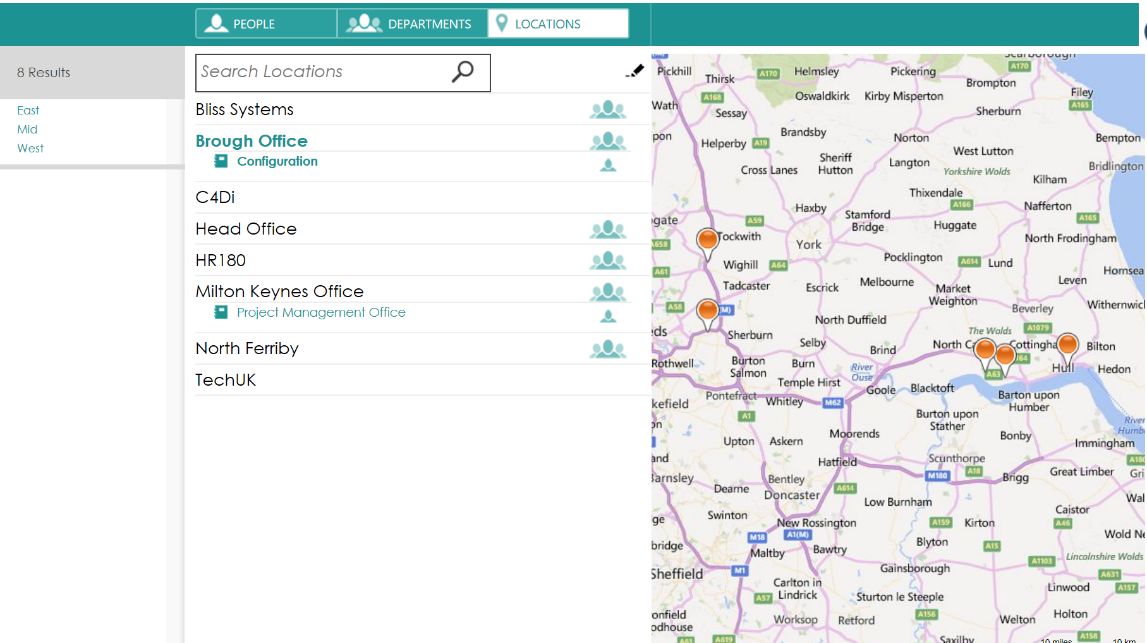
Although traditional staff directories often list departments and even have location addresses, these do little to actively connect the dots, showing how People are part of teams and work in places; how Places host Departments and are clustered or distant from each other on a map; how Departments are concentrated or diffused around their team members and office locations.
Who we are and what we do may not be defined by where we are and who we are with, but these certainly have a strong influence. Perhaps we should be treating it seriously, surfacing this information in our organisations beyond the scope of a simple directory and reflecting on what it means for our What, How and Why…

 Novia Works Ltd
One reply on “Putting people in their place”
[…] focuses on the People pillar, joining people with the their place of work and their main team (I blogged about this recently); Meson gives us a portal for business intelligence insights management and […]