

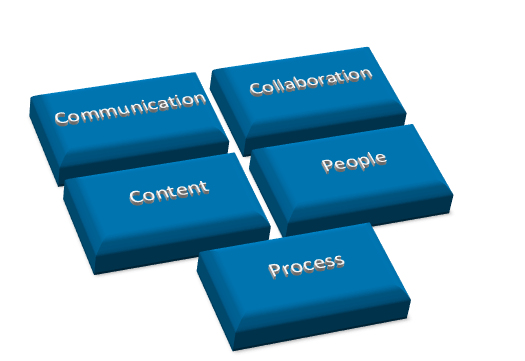
I talk a lot about the five pillars of enterprise intranets: Content, Communication, Collaboration, People and Process; in the past we were the first company to develop a solution accelerator for enterprise intranets. This became our Hadron 8020 portal and attempted to serve all those needs and act as the one place that users can go to carry out the organisational activities based on the way these five pillars interact. However times are changing, Microsoft have evolved their technology and, in the process made the overall technology landscape more complex and fragmented; this is beginning to have a knock-on effect on what’s needed from Hadron and other modern intranets.
We’ve already split out the business intelligence element that used to be within 8020 into its own portal (Meson BI) and increasingly we view intranet activities is being supported by a range of technologies, typified by the Office 365 stack, not just SharePoint:

With Microsoft pushing SharePoint down this table and somewhat into the background, to become more of a platform technology and with no easy way to integrate all the “Experiences” that Microsoft like to talk about, we are having to think hard about what the next generation of Hadron and other enterprise intranets might involve.
I have long held that there is a limit to the number of things that people can hold in their head at one time (neuroscience tells us this is five for most people) and within Hadron 8020 we tried to provide a structure and navigation best and only five kinds of places which people need to go to in order to find, save or manage their content. In the same way we can anticipate five portals depending on what people want to do.
So my thinking is gravitating towards a limited number of differing portals for different core activities: Hadron 8020 will tend to evolve around content and collaboration; Hadron Connect is a new portal which focuses on the People pillar, joining people with the their place of work and their main team (I blogged about this recently); Meson gives us a portal for business intelligence insights management and action; our partnership with the shiny new Flowforma technology (think workflows an forms) gives us the potential to develop an activities and processes based portal. Cognitively, we have room for one more portal… whatever that needs to be. Each of these can take advantage of the breadth of technologies, this simplifies the user experience by focusing on a user centric activity rather than the technology required.
It’s going to be important to ensure that these different portal experiences work well on the types of device people are using in the few years ahead, which means both massive collaborative screens and personal mobile devices and smart phones as well as the traditional desktop PC.
There is certainly more to come. People work on a broader variety of tasks in a wider range of locations and environments through an increasing number of devices. In the background the devices and services are getting smarter, prompting is for more and guessing what we need with artificial prescience that would have bordered on witchcraft 50 years ago. The tide of knowledge, information and data rises higher with each passing year and we need to evolve our tools for dealing with that to ensure organisational efficiency and competitiveness while protecting the limits of our minds.

 Novia Works Ltd