
This is effectively Part Three in a series of blogs on managing content across the organisation, as part of moving to a cloud. I’ve previously mused on Microsoft Teams and Office 365 Groups, as well as the complex issue of ‘Putability’.
It’s easy to think that covers everything, but every organisation has huge quantities of legacy content which can’t or shouldn’t be placed in a modern content management system. You can legitimately think about these being files and folders stored on a file server, with this commonly being mounted against a Storage Area Network (SAN).
As organisations either commit fully to the cloud and seek to remove their existing local servers, or are faced with having to upgrade their SAN yet again because of growing data volumes, they are often strongly tempted to offload some of this into their Office 365 cloud storage. There is a whole article on effective migration strategies, content cleansing etc. which should be the subject of a future blog. For now, I want to consider a much simpler problem of whether you should migrate legacy content and if so, to where.
Chances are you’ve found a file in your file share! It’s probably buried deep in a set of folders (and you can read what I have to say about that here). There’s probably a 50% chance that it’s out of date, duplicated multiple times and has no obvious or existing owner. It’s almost guaranteed that any metadata happens to be attached to it is wrong. It properly has siblings, tens of thousands of other documents in a similar state, all-consuming expensive and fast tier 1 storage. Something must be done!
Simplistically, you have three choices; the trick is to choose amongst them wisely and here are our thoughts (with thanks to Alan Ruan for the discussions that led to this).
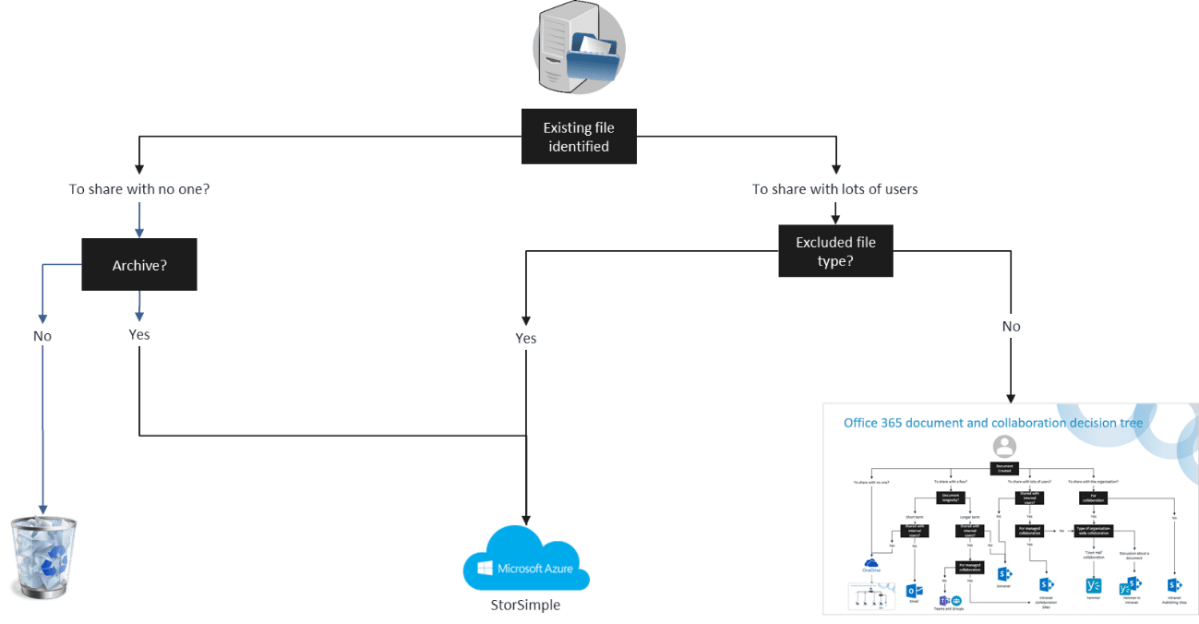
Do you need to share this file or document on an ongoing basis with colleagues in your organisation? If not, it’s probably a legacy file or document that no one actively needs. Now the question is do they need it at all?
If not, you can delete it. If so you need to archive it into an inexpensive storage tier. Once upon a time this could easily have been tape or a JBOD array. Today the chances are you look at something like Microsoft Azure StorSimple appliance which will synchronise content to the cloud while leaving a file stub that makes it appear to be local to your filing system. It’s pretty cheap, starting at about £100 for the virtual appliance per month plus storage at about £1200 per terabyte per year, which includes full redundancy etc.
If so it’s probably a live document and should be pushed into your digital workspace. I recommend going back and reading the blogs referenced in the first paragraph. However, you can’t put everything into SharePoint Online, OneDrive for Business etc. Many file types are actively blocked and some of the files you may be storing, such as video, CAD drawings, disc images and MSI files are just too big to comfortably move there. There are options to setup BLOB storage linked to SharePoint, of course. Equally you may be happy to leave this kind of content on something equivalent the file server as such content tends to be relatively small in quantity and often has a reasonably effective taxonomy which can be managed using folders. Once again, an option like StorSimple will allow you to move this to low-cost storage while retaining access and control.
As I said, it’s pretty simple. It’s even simpler when you can see it as a diagram:


 Novia Works Ltd