

Document digitisation has come a long way
A few days ago I opened a Coventry and Warwickshire Chamber of Commerce conference on AI and Cybersecurity with my perspectives on AI past, present and future.
While listening to another speaker I scribbled down some ideas for a blog around humans in the loop, based on prior discussions with other Microsoft MVPs and some comments in the conference. While I’m quite pleased with the blog idea I didn’t fancy typing it up from my paper notes. On the other hand, my handwriting, which was always dire, has declined through lack of use during the IT Age. If only AI could read such scrawl.
I’m always up for a challenge, so grabbed my phone, spun up the M365 Copilot app, which has a rather excellent document scanning capability, and digitised my handwritten notes.
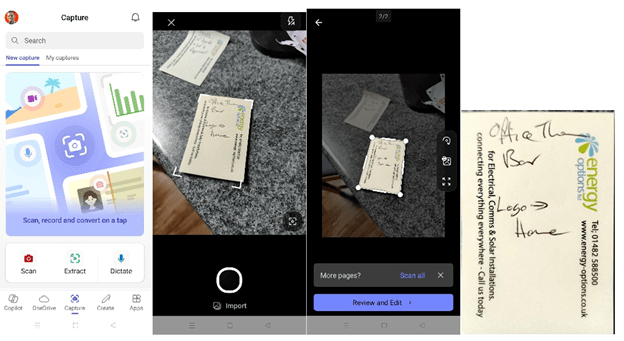
These are the actual captures from what I wrote – feel free to be judgemental about my writing:


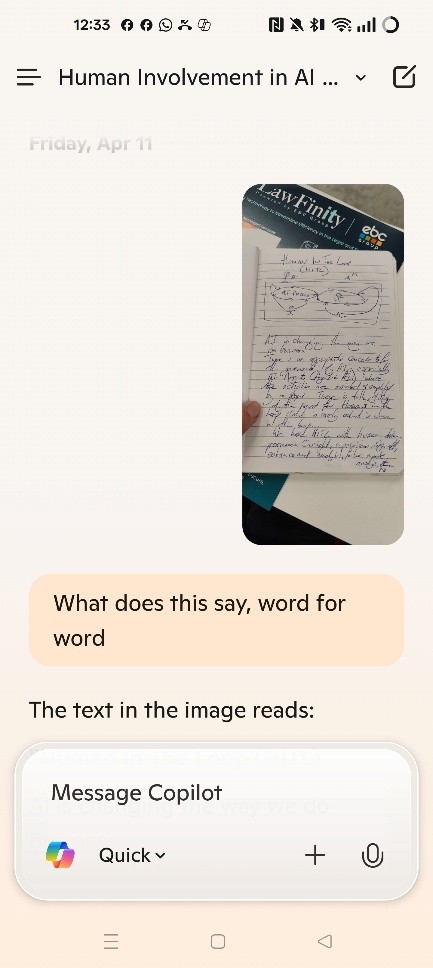
I used the Copilot Chat app on my phone (public Copilot) to transcribe my handwriting, uploading the images I captured. The prompt couldn’t have been simpler:
“What does this say, word for word”
The response was impressive. This is what it extracted from the 2 pages of hieroglyphs:
Human in the Loop (HITL)
AI is changing the way we do business.
There is an appropriate concern for AI governance (AI), especially AI Agents (Agentic AI), where the activities are initiated & completed by an Agent. There is talk globally of the need for Humans in the Loop. What is really needed is where we have HITL with human-driven processes. Oversight, supervision, sign-off, enhancement analysis, failure mode analysis, etc.
We consider when we insert to human oversight. We try to avoid micromanagement. Ideally we ask ‘Who watches the Watchmen?’ i.e. having oversight of the HITL to ensure that oversight is effective. Not all HITL humans are very fallible.
The same approach should surely apply to AI agents, with similar oversight. After all, AIs are fallible.
Given this apparent symmetry, perhaps we should also have AIs in the oversight loop. AIric.
As we move from AI as servant through AI as assistant to AI as partner, we need to consider not only pronounced HITL but also AIITE at both the process and executive oversight level.”**
It also had a go at interpreting the diagram, though sadly didn’t create a clever new version.
“It looks like the image discusses the importance of human involvement in AI-driven processes. Does this align with what you were hoping to learn from it?”
It even offered a handy analysis:
“It looks like the note discusses human oversight in AI systems, the need to avoid micromanagement, and even the idea of having AI involved in the oversight process itself. There’s also a reference to Coventry & Warwickshire Chamber of Commerce in the background. Does this align with what you were hoping to get from it?”
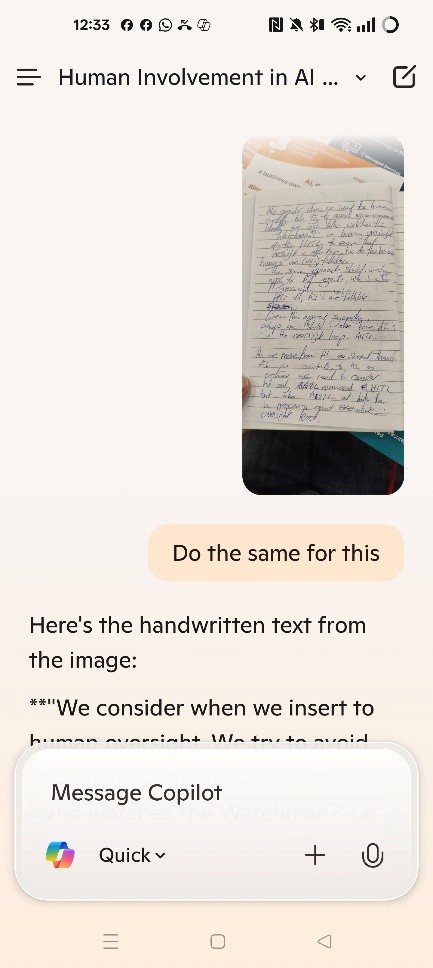
I challenge you to do better.
Let’s be critical. It’s not perfect. It has a handful of words wrong and struggled with my newly created acronym, AIITL (AI in the Loop). I challenge you to do better.
With the ready availability of typed, touchscreen and voice interfaces I’m unlikely to do this very often. However, I am suitably impressed with its attempt to extract content and context from even the worst of handwriting.
Score one for Artificial Intelligences.

 Novia Works Ltd