
The ethics of innovation in music, and why the way we create matters as much as what we create
In between my technology and sustainability interests I am also a musician and songwriter/composer. My back catalogue is large, often dusty, sometimes underdeveloped. Then I was introduced to Suno by another musician friend…
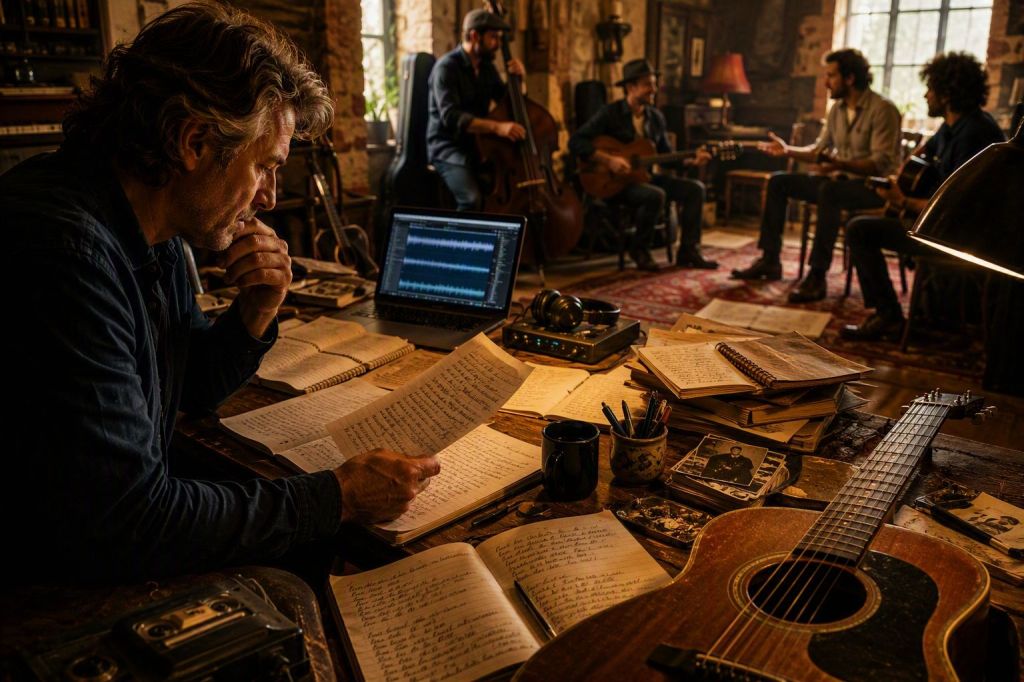
An unexpected consequence of my exploration of AI use in music is that I have rediscovered my songwriting muse. I am playing more, listening more and collaborating with a new circle of musicians, drawn in part by access to music I had long forgotten and can now present in a form that does it justice. I was going to write an article on Suno, but thinking about my use of Suno and conversations with others led me down this different path.
Over the years I have accumulated forgotten songs, unfinished recordings, abandoned lyrics and musical sketches that never quite found their way to completion. Like many songwriters, I have generally created ideas rather more successfully than I have finished them; though a couple of studio albums show I’m not a hopeless case. Of those incomplete, some were constrained by my own abilities, particularly as a vocalist. Others needed musicians, arrangements or recording resources that were not available when I wrote them. Eventually they slipped out of sight, surviving on old cloud drives, in notebooks and occasionally only in skanky recordings (I kid you not, some are unlistenable!).
Suno has enabled me to return to that material and hear it afresh. A rough guitar recording becomes a tolerable concept as the starting point for my fuller composition. Songs whose potential I could sense, but could not realise, have been explored in several musical directions, frequently leading to rewrites and new interpretations. It’s not the same as bringing musicians into a rehearsal room or studio, and I don’t mistake it for that. The Suno process is undeniably creative, but it is also somewhat isolating and transactional: I describe, generate, listen, revise and try again. It gets the job done remarkably well, while offering relatively few of the opportunities for personal enrichment that arise when people create together.
Excitingly, the result has not been the retreat into solitary, automated music-making that some might predict. I have found myself playing more guitar, not less. I have revisited old compositions, thought more actively about arrangement and re-engaged with songs I had effectively lost. Sharing some of those reimagined pieces with members of my gypsy jazz group has led to further musical conversations and collaborations. Songs that began their second lives in an interaction with software have subsequently entered rehearsal rooms with musicians I would not otherwise have involved.
For me, artificial intelligence did not replace the rehearsal room. It’s helped me find my way back into it.
My experience does not settle the argument about AI and music. While I have discovered that generative AI can lower barriers between imagination and execution, I’m concerned that it can also change or displace the human processes through which music has traditionally been made. It can broaden the range of ideas a songwriter can explore, while narrowing the opportunities to learn from another person during the exploration. It can produce an impressive artefact without necessarily providing the relationships, shared growth and sense of belonging that might have accompanied its human creation. It may be musical, but is it honest and true.
The proper question is not whether AI and advanced technology can and should be part of making music. It plainly can and already is. The more interesting question is what we believe music is for, where creativity resides, and which forms of value we want new technology to strengthen rather than quietly erode.
It matters how the process changes us,
As I thought about it I realised music creates value in more ways than I/we generally acknowledge. It matters what we create, how we create it, how the process changes us, and how we ultimately share it with other people. Those distinctions lie at the heart of the debate over artificial intelligence in music.
Why music matters
Music is not a peripheral human activity. Something recognised as music exists in every known human society, though the forms it takes vary enormously. The Natural History of Song project examined ethnographic accounts and recordings from a broad sample of societies and reported music in every society observed. It also found recurring associations between song and activities including infant care, healing, dance and love. Musical behaviour varied greatly, often more within societies than between them, but the presence of music itself was universal within the material studied.
That distinction matters. Music may be universal, but it is not a universal language in the simplistic sense that a piece carries the same meaning for every listener. Musical structures, conventions and emotional associations are culturally shaped. What appears universal is the human tendency to organise sound and to use it in socially and emotionally significant settings. In fact music is intensely individual; the songs that repeatedly send a shiver down my spine or make my eyes leak leave others weirdly unmoved.
Neuroscience adds another part of the picture. Research using neuroimaging has associated intensely pleasurable musical experiences with dopamine activity in the brain’s reward circuitry. The anticipation of an emotional peak and the experience of the peak itself involve anatomically distinct dopamine responses. Music does not merely arrive at our ears as a sequence of sounds. We predict it, anticipate it and become emotionally invested in where we think it is going.
Collective music-making may also contributes to social bonding. Studies and reviews have explored how synchronised movement, singing and rhythmic participation can promote a sense of connection between people, with proposed mechanisms involving interpersonal synchrony and the endogenous opioid system. Research has also examined possible links between musical activity, oxytocin and prosocial behaviour, although the precise mechanisms and their relative importance remain active areas of investigation rather than a closed case.
All of this aligns with what people have done throughout history. We sing to children, at worship, in celebration and in grief. We form choirs, bands, orchestras and informal sessions. Welsh male voice choirs, congregational singing, community brass bands, Irish traditional sessions, English folk clubs, bluegrass jams, gospel choirs, school ensembles and friends playing together in kitchens or pubs are not merely different methods of producing musical content. They are social practices. The process creates fellowship, identity, memory and belonging alongside whatever sound emerges.
The music industry matters, and professional creators have every right to defend their livelihoods. However, music long predates any industry built around it. Most people who make music do not do so primarily to earn a living. Amateur performers, community groups, hobbyist songwriters and people singing privately outnumber the comparatively small population whose principal income comes from music.
In fact, for many musicians the flow of money usually runs in the opposite direction. Instruments, rehearsal rooms, recording equipment, lessons, travel, venue hire and countless other expenses mean that music often costs its participants both time and money. Yet people continue to do it.
My song, ‘Just Do It For Love’ speaks explicitly to this (along with my trademark twist). If financial reward were the sole motivation, countless bands, choirs, folk sessions and community groups would never form in the first place. The rewards people are really seeking are often emotional, social and creative.
We make music because making music is part of being human.
That gives us an important standard against which to judge AI. Economic impact, ownership and commercial fairness are essential, but they are not sufficient. We must also ask whether the technology expands human expression, supports social connection and encourages participation, or whether it replaces those experiences with the convenient production and consumption of more content.
Music has always absorbed new tools
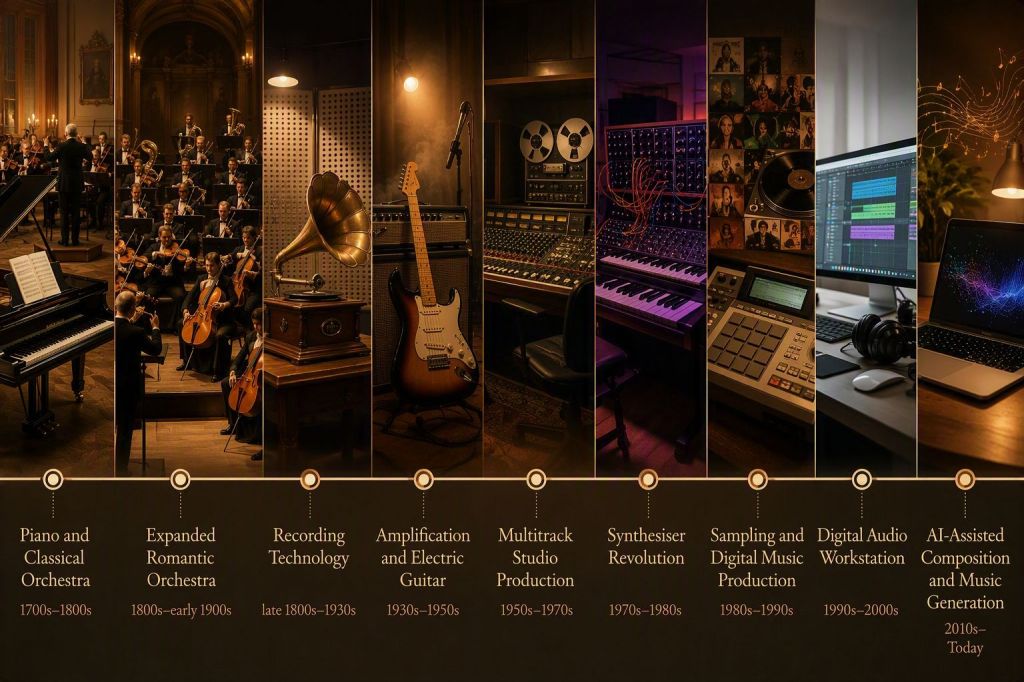
Recording brought a different disruption by separating a performance from the moment and place in which it occurred. Amplification altered instruments and made new kinds of venue, technique and genre possible. Multitrack recording allowed musicians and producers to construct performances that had never occurred as a single live event. Tape manipulation, editing, effects and overdubbing helped establish the studio as an instrument rather than merely a room in which an existing performance was documented.
None of this tension between musical tradition and technological change is new. Some musicians resist innovation because it threatens familiar skills, aesthetics or livelihoods. Others embrace it because it expands their creative possibilities. Often both groups have reasonable points, and history subsequently absorbs the disruption so completely that the once-controversial tool becomes part of what later generations call authentic music.
The piano was itself an enabling technology. Its ability to vary dynamics through touch opened expressive possibilities unavailable on the harpsichord. Beethoven pushed both instruments and performers towards greater range, power and durability because the available technology did not yet fully accommodate the music he imagined. Berlioz expanded ideas about orchestral colour and scale. Wagner reshaped the relationship between music, drama and the theatre, even commissioning a new instrument, the Wagner tuba, for the sonority he wanted. In the twentieth century, composers including Edgard Varèse, Karlheinz Stockhausen and Wendy Carlos explored electronic sound not as a poor imitation of established instruments but as creative material in its own right.
Synthesisers were criticised for replacing real instruments before becoming real instruments in the hands of musicians. Sampling provoked particularly difficult questions because its raw material was often somebody else’s recording. It nevertheless developed into a recognisable creative practice, while copyright law and licensing attempted, not always elegantly, to balance transformation with the rights of earlier creators.
The historical analogy is useful, but it should not be overworked. Saying that previous technologies were resisted does not prove that every concern about AI is mistaken. It tells us only that novelty is not, by itself, evidence of artistic illegitimacy. Generative AI must still be examined on its own capabilities, consequences and ethical choices.
Creation is not a single act
Part of the confusion comes from talking about musical creativity as though it were one indivisible activity. It is not. A musical idea, a composition, an arrangement, a performance, a recording and a production are related but distinct things. They may be undertaken by one person, but throughout most musical history they have frequently been distributed among composers, arrangers, conductors, performers, producers and engineers.
We do not normally argue that a composer failed to create because somebody else performed the work, or that a singer failed to contribute because somebody else wrote the song. A conductor can shape an interpretation without composing a note. A session musician may transform a recording through choices that were not specified in the score. A producer can change the emotional force of a song through arrangement and sound. Authorship and creativity have always been layered.
Technology has progressively democratised execution. A piano enabled one performer to articulate harmony, melody and rhythm together. Recording preserved and multiplied performances. Multitracking allowed one musician to become an ensemble. Digital audio workstations placed facilities once restricted to expensive studios onto domestic computers.
Generative AI goes further because it can participate in arrangement, orchestration, interpretation and apparent performance. That makes the boundary harder to draw. If I write the lyrics and melody, provide an original recording, specify the instrumentation and emotional trajectory, reject unsuitable versions and repeatedly refine the result, my creative intention is clearly present. The AI has nevertheless made many decisions that a human arranger, producer or performer might otherwise have made. Conversely, entering a brief prompt and publishing the first output involves a much thinner form of human contribution, even if choosing the prompt is not literally no contribution at all.
We need a vocabulary richer than either “human-made” or “AI-made”. Creativity is not a switch. It is a spectrum of intention, judgement, selection, craft and influence. Honest discussion requires us to recognise the difference between AI as a sketching partner, an arranger, a production tool, a synthetic performer and an almost autonomous generator. Those uses are not creatively or ethically equivalent.
Why AI really is different
The precedents of the piano, the electric guitar, the studio, the synthesiser and the sampler establish that technology can become part of musical artistry. Using new tools has always been part of the art of music. In this context, generative AI is just another tool; on the other hand it is genuinely different in several ways.
The first is training. These systems acquire their capabilities from very large bodies of existing material. Musicians and rights-holders reasonably ask whether protected recordings and compositions were used with permission, what constitutes lawful learning or copying, and how creators should be credited or compensated. The legal answers vary by jurisdiction and remain contested. The ethical question is broader than the eventual outcome of any particular lawsuit: a sustainable creative ecosystem cannot depend on treating the work of human creators as an inexhaustible, ownerless raw material. I was pleased that the V6 release of Suno is explicitly trained only on music they have licensed for this purpose, removing some of the ethical concerns.
There is a precedent in sampling, but it is an incomplete comparison. A recognisable sample can often be identified and licensed. The influence of millions of training examples on a generated output is diffuse, while a model may still occasionally produce material uncomfortably close to an existing work. Practical protections will need to include legitimate training arrangements, reliable detection of matching material, clear routes for challenge and systems of licensing or compensation that are workable for creators as well as technology providers. I note that Suno has robust copyright protections. In fact it is often overly protective, triggering false positives against legitimately original material and without any appeals process.
The second difference is identity. A synthesiser can imitate the broad timbre of a class of instruments. Modern generative systems can potentially imitate a recognisable singer or performer. That introduces questions of consent, reputation, fraud and personal autonomy that cannot be reduced to conventional copyright. An artist’s voice and identity should not become freely available production settings simply because they can be modelled.
Deepfake protection therefore needs several layers: restrictions on non-consensual impersonation, provenance information that survives distribution, appropriate labelling, accessible reporting and removal processes, and meaningful consequences for deliberate deception. (Again, Suno has effective measures to prevent deep fake voices. The UK government is planning legislation to ensure people own their own voice (and other personal characteristics). Nevertheless, none of the protections are perfect on its own. Watermarks can be stripped, labels can be omitted and detection systems can make mistakes. The objective should be accountable transparency rather than the pretence that one technical mechanism will solve a social and legal problem.
This is also where consumers enter the argument. We do not yet have enough evidence to claim that audiences will either reject or embrace AI-generated music as a single category. Their responses are likely to depend on context. A listener may be relaxed about an openly AI-assisted arrangement of its author’s original song while objecting strongly (as I think they should) to a synthetic performance falsely attributed to a living artist. The central issue may be less whether AI was involved than whether anybody was deceived, exploited or displaced without consent.
Collaboration matters
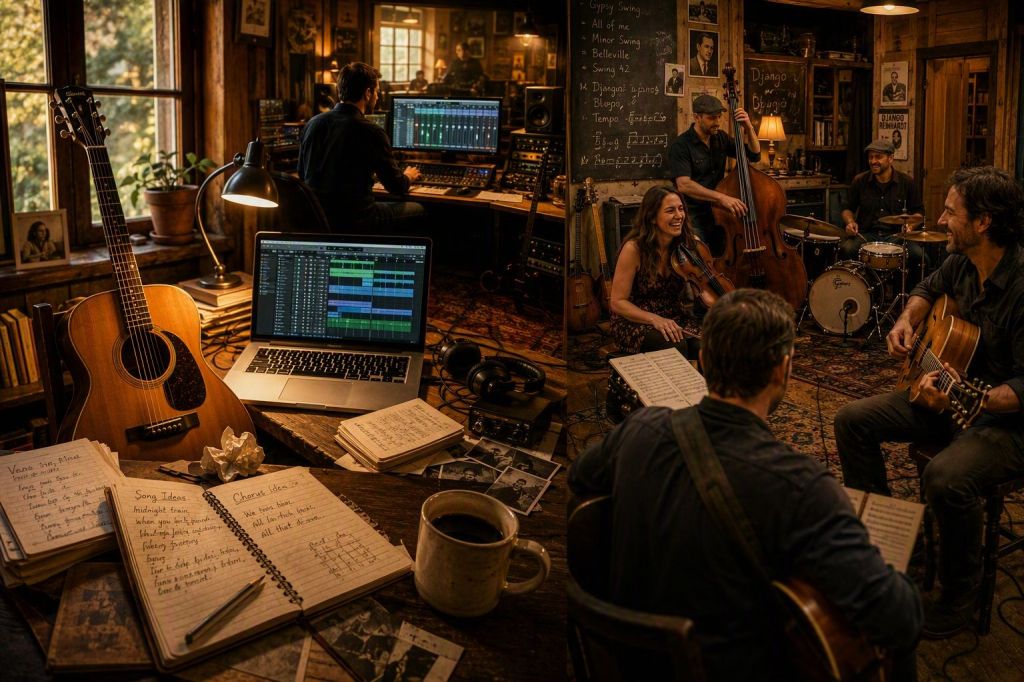
For a songwriter, one of AI’s most striking attractions is the breadth of possibility it can expose. The musicians available for a conventional collaboration inevitably shape what can be explored; that is the nature of an ensemble.
A four-piece pop band is unlikely to veer spontaneously into a chamber interpretation of a song. A folk group may not propose a gospel arrangement. A string quartet will hear and solve a musical problem differently from a rhythm-and-blues band. Each group brings capabilities, tastes, habits and blind spots. The musicians inspire one another, but they also define the practical and imaginative boundaries within which the work develops.
Generative AI can move between those possibilities in seconds (minutes actually, but the point remains). It can reveal that a melody survives a radical change of tempo, that a lyric gains weight when the harmony is simplified, or that a song written on an acoustic guitar contains the bones of something orchestral, electronic or choral. Used well, this isn’t just novelty. My experience has been that contrasting interpretations can expose qualities within a composition that the songwriter had not recognised, but can then build from. They can also reveal those qualities to different audiences. A strong song may be overlooked, dismissed or never even encountered in one genre, yet resonate deeply when presented in another. Listeners who would never choose to engage with a folk ballad may connect with the same melody and lyric when reimagined as jazz, orchestral music, contemporary pop or something else entirely.
In that sense, alternative arrangements do more than offer creative variety. They can become a way of discovering audiences for the underlying songwriting itself. Sometimes the arrangement changes. Sometimes the audience changes. Occasionally both do.
Breadth is not the same as collaboration.
A rehearsal contains negotiation, humour, frustration, generosity, disagreement and surprise. Musicians learn one another’s musical languages. A drummer changes how a guitarist feels time. A singer reveals that a carefully written phrase is unsingable or that an apparently simple line carries an unexpected emotional emphasis, though a different singer may nail it as written! People become more capable through the encounter. Relationships develop. The participants leave with more than the arrangement they produced. This is important, musically and socially. I played the lovely ‘Annie’ with three different ensembles, then with the fourth discovered a new outro that lifted the emotional impact further.
An AI interaction can be creative and demanding, but it remains largely transactional. I ask, it responds; I judge, revise and ask again. The model does not bring a personal history into the room, learn a new technique from me or leave the session inspired to change its playing. It can enrich my thinking through what it produces, but there is no mutual enrichment because there is no second lived experience on the other side of the exchange. Nevertheless, the Annie experience has also occurred using Suno, where experimentation led to adding a pre-chorus to ‘Please come back to me’ that enriches the composition and allows for a longer, more sophisticated arrangement.
All this produces a risk that should not be dismissed. We could increase the quantity and stylistic range of music while reducing the number of occasions on which people make it together.
More musical output would not necessarily mean a richer musical culture. If fewer people learn instruments, join bands, sing in choirs or participate in local sessions because generated music is easier, we may lose benefits that are not audible in the final file: confidence, discipline, empathy, friendship, mutual dependence and community.
The risk is not unique to AI. Recorded music already shifted many people from participation towards consumption, while domestic studios enabled forms of solitary creation that once required a group. Previous technologies brought losses as well as gains. I remain strongly of the view that acknowledging this does not require us to reject the Innovations. We do need to decide which human activities deserve active protection and encouragement, and never assume that the market will preserve them automatically.
Four kinds of musical value
In my thinking , I have identified four overlapping kinds of value in music.
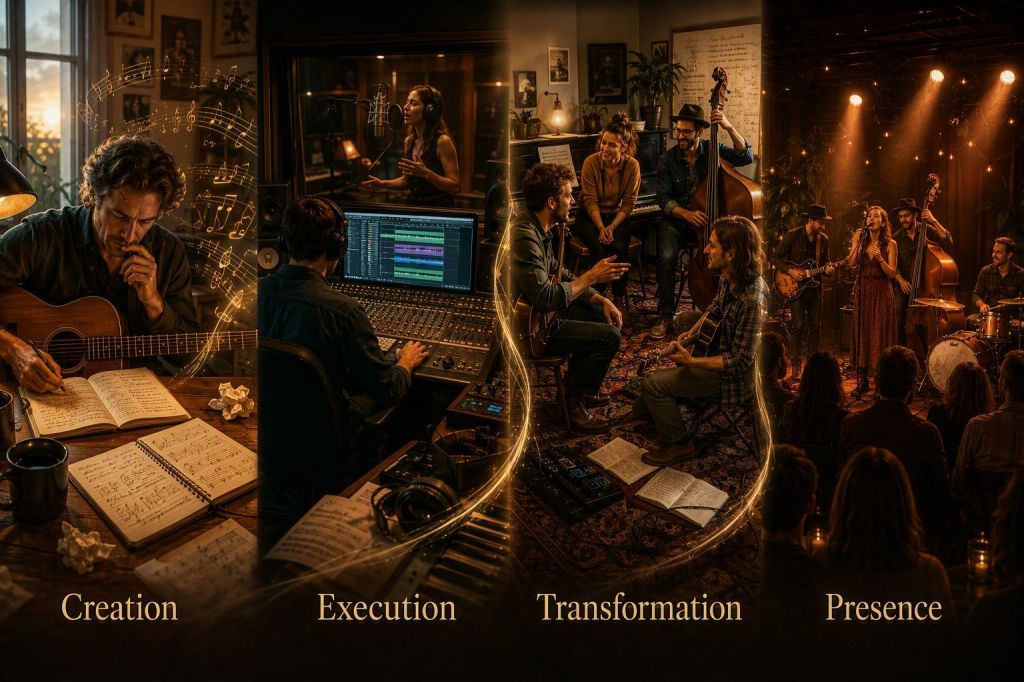
Creation is the formation of the idea: the lyric, melody, harmonic movement, emotional purpose or conceptual spark. And the story worthy of being told, of course.
Execution is the work of giving that idea audible form through arrangement, performance, interpretation, recording and production.
Transformation is what happens to the people involved while they make the music. They learn, practise, listen, negotiate, take risks, develop relationships and sometimes understand themselves differently. Form me it’s been an essential part of personal growth.
Presence is the human encounter around music: performers and audiences sharing time, attention and vulnerability in a room, or a community. Our shared experiences.
These are not rigid categories, and AI may touch all four, to differing extents. A creation can provoke a genuinely new creative thought. It can execute an idea with previously inaccessible instrumentation. It can transform the understanding of a composition. It can even contribute to an experience that moves an audience. But its strengths are presently concentrated in creation and execution, particularly in moving quickly between an intention and a plausible-sounding realisation.
Transformation and presence are more difficult. They depend heavily on relationships, embodiment and shared experience. A flawless synthetic performance may move a listener, but it does not itself experience the risk of performing. Some of most memorable moments have been when performing in adversity. Look up the legendary Keith Jarrett Koln Concert performance. A generated arrangement may transform its human user, but it is not mutually transformed. Nor does it create those moments of adversity I alluded to, that are rich sources of inspiration. The distinction does not render the artefact worthless. It reminds us that the artefact is not the whole of music’s value.
We must avoid a false contest between human and machine processes. The objective need not be to choose one route exclusively. AI can be used early to explore arrangements before human rehearsal, to make a compositional idea legible to potential collaborators, or to produce a reference that musicians subsequently dismantle and rebuild. Human collaboration can then add interpretation, capability, relationship and presence that the generated version cannot supply. These are all artistically worthy, and rejecting AI as a tool risks losing new artistic opportunity.
The future of music (and other arts and creative endeavours) depends partly on design, policy and economics, but also on the choices musicians make. If AI becomes a substitute for every difficult or inconvenient encounter with another person, its efficiency will impoverish us. If it becomes a means of surfacing ideas, extending access and inviting further participation, it can enrich musical life.
Me and Suno
I use Suno partly because I have limited vocal ability and cannot always execute the songs I write in the form I imagine. Suno lets me test whether an idea works beyond the limitations of my demo. It lets me hear alternatives and distinguish weaknesses in the composition from weaknesses in my performance. Occasionally it produces something I would not have conceived with the people and instruments immediately available to me.
It is important to understand what I mean by AI-assisted creation in this context. In almost every case, the songs already existed before I opened Suno. The melodies existed. The lyrics existed. Rough recordings existed. What often did not exist was a convincing realisation of those ideas.
My typical workflow begins with material I have already written. I upload recordings, refine lyrics, define musical direction, experiment with arrangements and repeatedly iterate. Versions are generated, evaluated, rejected, revised and regenerated. Sometimes dozens of attempts are explored before a song begins to resemble the version I have in my head.
Far from removing effort, the process often demands a great deal of it. It requires musical judgement, critical listening, persistence and a willingness to discard superficially impressive results that are fundamentally wrong for the song. The technology accelerates aspects of execution, but arriving at a satisfying outcome remains an iterative and sometimes surprisingly arduous process.
What Suno contributes is never the original spark of inspiration. It does help bridge the difficult gap between imagination and execution.
My Suno Workflow: More Craft Than Button Pressing
People often imagine AI music generation as an instant process. My experience has been very different. A typical song takes several days of iterative work before I consider it finished.
- Find old recordings of my music, or record new ideas on my phone.
- Import the recording into Suno.
- Painstakingly correct and update the lyrics.
- Carefully define the overall musical style, instrumentation, playing techniques, vocal characteristics, production approach and ambience.
- Add arrangement cues directly into the lyrics, including song sections, instrumentation, emphasis and detailed musical directions.
- Set generation parameters, including:
- Vocal gender(s)
- Style definition influence
- Uploaded audio influence
- Weirdness (AI creative latitude)
- Create detailed performance instructions where needed, for example:
[Verse 1]
[Vocal enters, emotional, emphatic]
[Mandolin picks melody]
[Pennywhistle harmonises vocal]
- Generate the song.
- Review the two versions Suno creates.
- Add comments describing required changes.
- Select the preferred version or discard both.
- Adjust and refine the prompt, lyrics or arrangement.
- Regenerate.
- Repeat until the song achieves the desired result.
- Update the track title and description.
- Create and embed cover artwork.
- Assign the song to a workspace and playlist. Optionally publish the track.
- Tidy up and delete unwanted drafts.
- Update my master music notebook in OneNote with revised lyrics, arrangements and chord structures.
- Download as WAV and convert to 16-bit, 48 kHz FLAC.
- Update all metadata tags and reapply artwork. Add a “Made with Suno” attribution and my copyright notice to the metadata.
- Add the finished track on my music serve. Optionally upload it to Tribal.
- Listen critically on a good hi-fi system to ensure the track meets my musical standards.
Typical elapsed time: 2–3 days per song.
The process resembles directing a recording session with an infinitely patient and exceptionally versatile virtual band. The challenge is rarely generating options; it is developing the musical judgement to recognise which option best serves the song.
Anyone curious about the results can judge for themselves. I publish many of my songs on my Suno profile (and on Tidal). Please comment if you do listen; feedback is another thing missing without a live audience.
https://suno.com/@simon_hudson
I encourage listeners to approach the music exactly as they would any other song and ask a simple question: does it connect emotionally? That may ultimately matter more than the technology involved in realising it.
Finding my way back to the rehearsal room
All that is enormously valuable, but it is not magic and it is not authorship without responsibility. The quality of the process depends on what I bring to it: years of listening and playing, the original song, the ability to recognise what serves it, and the patience to discard outputs that are only superficially impressive. AI can make execution easier. It cannot decide what I was trying to say, I must undertake that myself.
Nor has easier execution made me less interested in playing. Quite the opposite.
Rediscovering older material has encouraged me to pick up the guitar more frequently (ask my wife). Once a forgotten song becomes audible again, I want to understand it, play it and see what it might become in human hands. The generated arrangement does not have to be the destination. It can be a provocation, a demonstration or a map pointing towards several possible destinations.
Sharing those pieces with members of my gypsy jazz group has reinforced that lesson. Reimagined versions have prompted interest from musicians who would not otherwise have encountered the songs. We have taken material into rehearsal, where it immediately ceased to belong to the generated arrangement and became subject to the instincts, competencies and interests of the people present. The AI offered breadth. The musicians supplied relationship, judgement, physical performance and a new kind of creative constraint. The result is not a simple story in which technology either replaces collaboration or leaves it untouched.
Suno removed some of the practical need for collaboration at one stage while creating reasons for it at another. It gave neglected ideas sufficient form to attract human attention. That transactional process became the catalyst for a relational one.
The same technology could clearly be used to avoid musicians, reduce costs, or produce an endless stream of disposable material. However, my experience demonstrates that AI-assisted creation need not be a retreat from musicianship. It can lead back towards practice, performance and community.
What should we ask of AI music?
Perhaps the wrong question is whether AI can make music. Music has never been difficult for humanity to make. Every known culture has developed it, without waiting for professional studios, formal copyright law or generative models. The more useful question is whether AI helps more people participate in one of humanity’s oldest and most universal forms of expression while respecting the people and relationships from which musical culture grows.
That requires more than technical capability. Training and licensing need arrangements that recognise creators rather than quietly externalising the cost of creative material. Artists need meaningful protection against non-consensual impersonation. Audiences need sufficient provenance and disclosure to make informed choices. Musicians and educators need reasons and spaces to continue collective practice even when solitary generation is easier and cheaper.
It also requires a more mature understanding of authorship. We should be able to acknowledge substantial human creative direction without pretending that a generated vocalist or arrangement was conventionally performed. Equally, we should resist treating every use of AI as identical. A tool used to realise its author’s long-neglected song is ethically and creatively different from a synthetic imitation designed to trade on somebody else’s identity.
For me, the benefits are real. As a songwriter, AI has helped bridge the gap between imagination and execution. It has allowed forgotten work to be heard, tested and developed. As a performer, it has reminded me why presence matters and why playing with other people produces kinds of value that no finished recording can contain.
The AI route is undeniably creative, but it is also transactional. It can get the job done while offering fewer opportunities for mutual growth during the process. Human collaboration is slower, bounded by the competence and interests of those involved, and sometimes gloriously inefficient. Yet it changes the people in the room as well as the music they make.
The AI route is creative, but transactional. Human collaboration is creative, but transformational.
We should preserve both truths. AI can broaden creative possibility beyond the practical reach of a particular group. Collective music-making can provide depth, enrichment and belonging that breadth alone cannot replace. Used carelessly, the first may diminish the second. Used thoughtfully, it may provide new material, confidence and impetus for people to come together.
That has been my experience. Suno did not make me abandon the guitar. It encouraged me to play it. It did not close the door on collaboration. It brought forgotten songs far enough into the light that other musicians could walk through that door with me.
More than that, it helped me rediscover my songwriting muse. Not because it wrote songs for me, but because it helped me reconnect with songs that were already there, waiting to be heard again, at a time my musicianship has matured and I have new tools to work with. In doing so it led me back towards playing, listening, performing and collaborating. The technology was not the destination. In many ways it was simply the route by which I returned to the music.
The future of music need not be a choice between people and machines. It can be a partnership between human intention and increasingly capable tools, provided we judge that partnership by more than the quantity or polish of its output. We should ask what it enables people to express, what rights it respects, what relationships it creates or displaces, and whether the process leaves human musical culture richer.
History suggests that musicians who embrace new instruments often help shape the future. The challenge is to do so without forgetting why humans made music in the first place.
End note
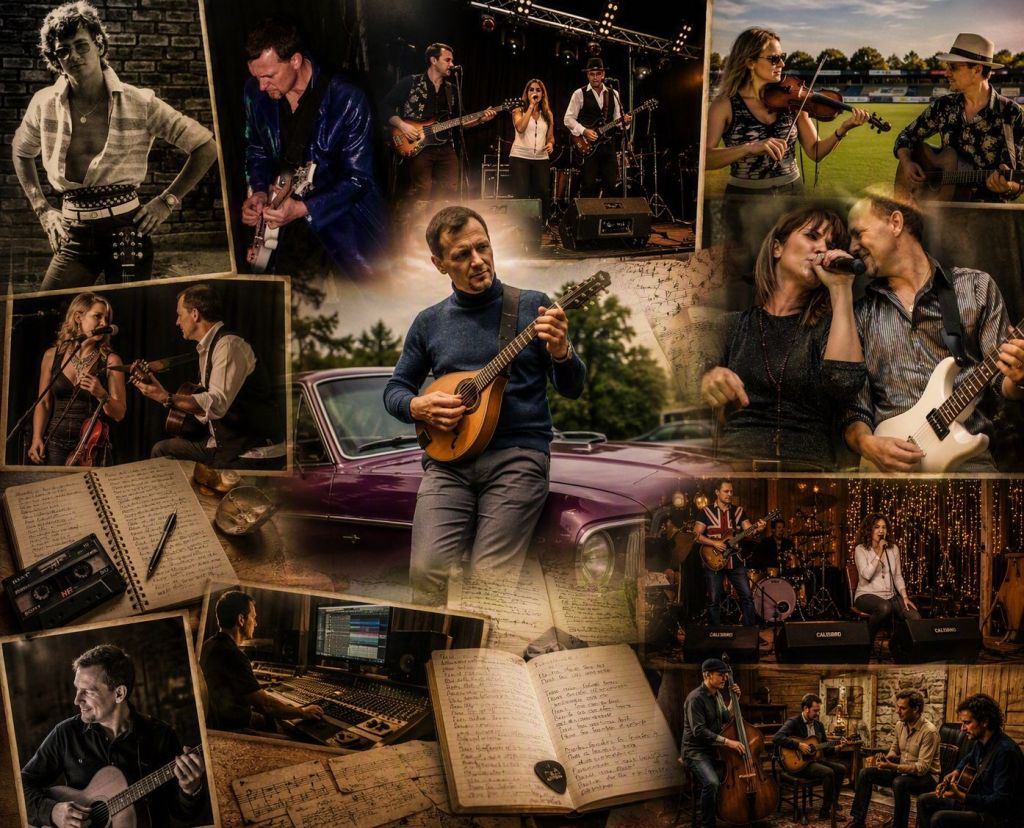
Full disclosure: I used AI to help create this article. The artwork is obvious; my graphical skills are akin to my vocal ability; neither should be on your list of experiences.
I then used Copilot extensively to shape the article. I laid out the concepts, insights and story arc; it pulled in reference material, editorial advice, crafted some of my weak prose, suggested angles I hadn’t considered. I argued, rejected, rewrote and extended. We went back and forth, over a week. Then I reread and edited it three last times. It’s a long read, it’s a longer edit! Even with AI there are hours of direct effort, not including thinking time, reflection and conversations with friends and musicians. And that’s the point; AI as a tool to improve the productivity of human creativity and expression.
References and further reading
Mehr, S. A. et al. (2019), ‘Universality and diversity in human song’, Science, 366(6468), eaax0868.
Read the open manuscript in PubMed Central.
Savage, P. E. (2026), ‘Universals: Absolute, Statistical, and Non-Universal Aspects of Music Beyond the “Universal Language” Metaphor’, in Comparative Musicology: Evolution, Universals, and the Science of the World’s Music.
View the chapter at Oxford Academic.
Salimpoor, V. N. et al. (2011), ‘Anatomically distinct dopamine release during anticipation and experience of peak emotion to music’, Nature Neuroscience, 14, 257–262.
View the paper at Nature.
Tarr, B., Launay, J. and Dunbar, R. I. M. (2014), ‘Music and social bonding: “self-other” merging and neurohormonal mechanisms’, Frontiers in Psychology, 5, 1096.
Read the paper in PubMed Central.
Harvey, A. R. (2020), ‘Links Between the Neurobiology of Oxytocin and Human Musicality’, Frontiers in Human Neuroscience, 14, 350.
Read the review at Frontiers.


