
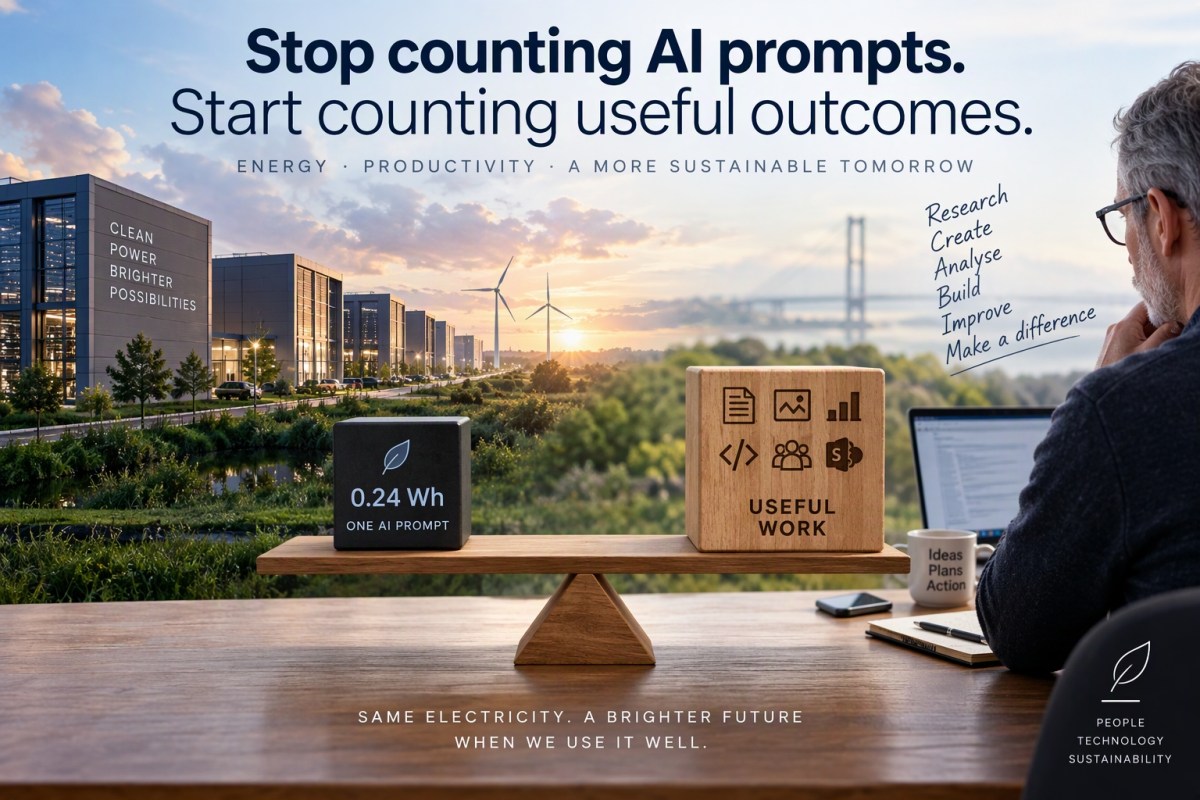
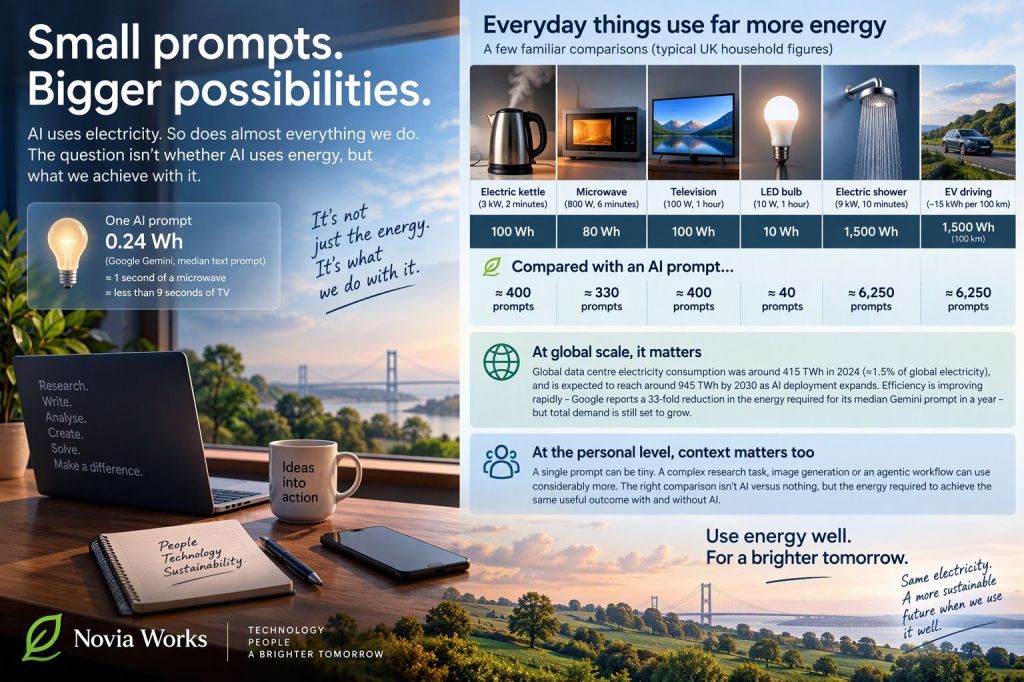
I was prompted to write this by Hanna Radtke Bergström’s article, which discusses the energy used by artificial intelligence and includes a wonderfully tangible number. Google has measured the electricity used by a median Gemini Apps text prompt at around 0.24 watt-hours (Wh), roughly equivalent to running a microwave for a second. Google’s calculation is broader than simply measuring the AI accelerator; it also includes supporting CPU and memory, provisioned idle capacity and data-centre overhead.
For a slightly more British comparison, a 3 kW electric kettle running for two minutes uses about 100 Wh. On that basis, you could make something like 400 ordinary text prompts for the electricity used in one two-minute kettle boil. That is a surprisingly small amount of energy, particularly given some of the rhetoric around AI, but it immediately raises another question. What exactly do we mean by a prompt? Asking AI to correct a spelling mistake and asking it to conduct a substantial piece of research may each start with a single instruction, but they clearly aren’t equivalent computational tasks. If we are going to have a sensible discussion about the energy consumption of AI, counting prompts is probably not the way to go.
Not all AI tasks are equal
I use AI for a wide range of things, from quick questions and reminders of things I have forgotten, to deeper reasoning, research, image generation, analysing and adding features to SharePoint sites and working with data. Increasingly, I also use agentic systems where I specify an outcome and allow the AI to work out many of the intermediate steps. A single request might cause the system to read documents, search for information, reason about what it has found, call tools, create something, inspect the result and make corrections. From my perspective that may still look like one prompt, but behind the scenes it could involve dozens of separate computational operations.
Unfortunately, most AI providers don’t yet publish enough information to tell us precisely how much energy each of these activities consumes. Google’s 0.24 Wh measurement is useful because it provides a real operational reference point for ordinary text interactions, but it would be wrong simply to apply that figure to everything else. Published research into image generation, for example, has found very large differences between models, with one comparison of 17 models reporting a 46-fold variation in energy consumption. Resolution, model architecture, hardware and the number of attempts required to get a usable result all matter.
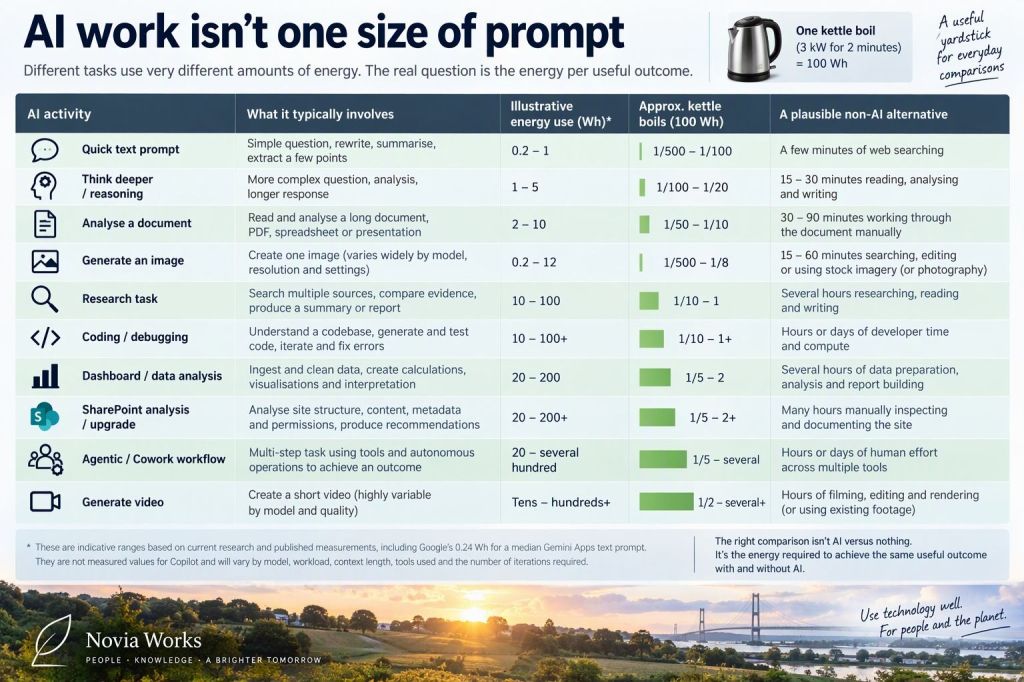
We can, however, use the evidence that is available to construct an illustrative energy ladder. The figures below should be read as orders of magnitude rather than measurements of any particular Copilot, Gemini, ChatGPT or Claude workload. The lower end is supported by reasonably good real-world measurements; uncertainty becomes progressively greater as the workloads become more complicated.
| AI activity | Illustrative energy range | Everyday comparison |
|---|---|---|
| Quick text question | 0.2–1 Wh | Seconds of television |
| Think deeper / reasoning | 1–5 Wh | LED lamp for several minutes |
| Analyse a substantial document | 2–10 Wh | Roughly minutes of television |
| Generate one image | 2–20 Wh | A few minutes of television |
| Complex research task | 10–100 Wh | Up to roughly one kettle boil |
| Coding/debugging session | 10–100+ Wh | Tens of minutes of laptop use, or equivalent boiling a kettle |
| Build/analyse a dashboard | 20–200 Wh | Roughly one or two kettle boils at the upper end |
| SharePoint analysis/upgrade | 20–200+ Wh | A couple of kettles-worth |
| Cowork/agentic workflow | 20 Wh to hundreds of Wh | Also several kettle boils |
| Generate video | tens to hundreds+ Wh | Potentially one of the most energy-intensive everyday generative workloads. Think fan heater… |
Whether a research task uses 15 Wh or 150 Wh will depend on how much information is processed, which models are involved, how many searches and retrieval operations are performed, how much reasoning takes place and whether the system has to go back and correct its work. The same applies to coding, dashboards and agentic work. The table is useful for giving us a sense of scale, not for pretending that measurements exist when they don’t. It would be unreasonable to assign more precise figures than these on the complex tasks.
It does, however, illustrate something useful; even a fairly substantial individual AI workload may consume electricity on the scale of one or a few kettle boils, while a quick text interaction sits hundreds of times below that. That doesn’t make the electricity free, nor does it tell us whether using it was justified. It simply gives us a more useful sense of proportion.
Energy per outcome
There is another point in Hanna’s article that I think matters even more. Rather than concentrating only on the energy consumed by AI itself, we should consider the energy required to achieve the outcome.
We should use ‘energy required to achieve the outcome’ as our metric.
If an AI system uses 50 Wh to help me conduct a piece of research, it is tempting to treat that 50 Wh as additional electricity consumption. That only works if the alternative was to do nothing; in reality, without AI I might have spent several hours using a workstation and multiple monitors, making searches, opening websites, reading documents, taking notes, comparing sources (drinking multiple cups of tea) and eventually writing the result. The conventional process uses electricity as well, both locally and in the servers and networks supporting all those digital services.
Even a modest laptop, monitor and associated equipment can easily average something approaching 100 W while being used. An additional hour of computer-based work would therefore consume roughly the same 100 Wh as our two-minute kettle boil, before we attempt to account for all the remote services involved. If AI consumes 50 Wh but eliminates several hours of conventional computer activity, simply describing that 50 Wh as additional energy misses an important part of the calculation.
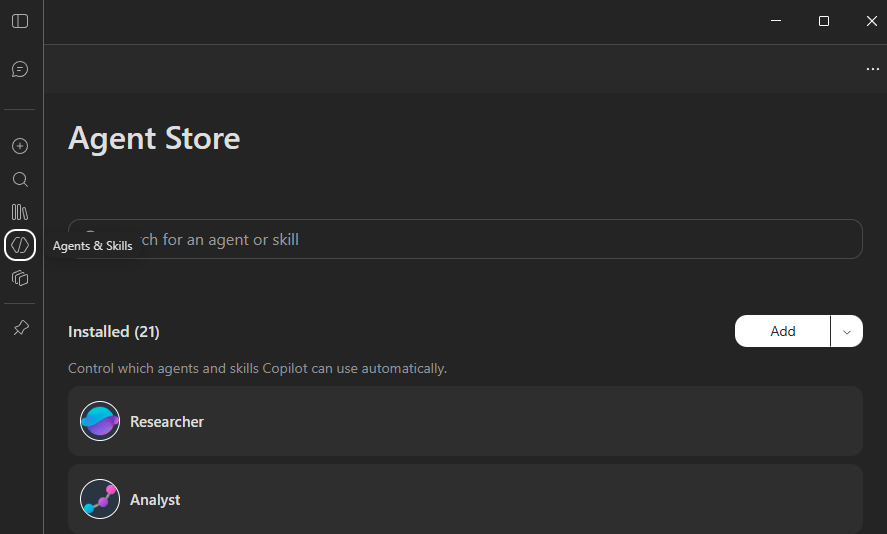
Let’s take my regular research queries as an example. A substantial briefing produced conventionally could involve several hours locating suitable material, reading it, following references, making notes, reconciling conflicting evidence and turning all of that into coherent writing. A Think Deeper, or full Research AI prompt may consume much more electricity than an ordinary text prompt, but if it reduces an eight-hour research exercise to two or three hours of AI-assisted work and human verification, we need to compare the whole of one process with the whole of the other. More importantly, we need to compare outcomes of equivalent quality; an instant AI answer that contains mistakes is not equivalent to a properly researched human(+AI) report.
Coding is much the same. Developing software conventionally involves a computer, multiple displays, development environments, compilers, test systems, web searches, documentation and repeated attempts at solving problems. AI coding assistance adds data-centre computation, sometimes quite substantial computation, but if it produces correct and properly tested software materially faster, the meaningful measure is the energy used to produce the completed working feature, rather than the number of prompts or model calls involved.
I also see something similar with SharePoint. Properly reviewing and enhancing a SharePoint site can involve hours of examining content, libraries, metadata and information architecture, identifying needs and constructing new lists. libraries and pages. AI can undertake parts of that analysis and allow me to concentrate on the judgements that actually require my experience. The AI may use tens or conceivably hundreds of Watt hours doing the work, but the conventional alternative could involve many additional hours of computer use. Dashboard development, spreadsheet analysis, presentations and document reviews follow much the same pattern.
Agentic systems such as Cowork extend this further. When I give an agent an outcome rather than a tightly defined individual instruction, the system may undertake a considerable amount of work on my behalf. The energy consumption will be much higher than a quick prompt, but the relevant comparison is with the hours of conventional work required to produce the same outcome. A workflow consuming the equivalent of three kettle boils isn’t necessarily wasteful if it replaces a day’s worth of computer-based activity.
Of course, this doesn’t mean that AI always reduces energy consumption. If I use AI to create something that I wouldn’t otherwise have created, most of that energy consumption is genuinely additional. I may get lazy with my prompts and have to go round the loops unnecessarily, generate 20 images in order to use one, an AI coding tool might produce unreliable software that requires hours of correction, or I might go down a rabbit hole and research and write more than needed. All these and more will increase rather than reduce total resource use. Energy per outcome only makes sense when we are honest about what the alternative would actually have been.
An article like this one
Let’s use this article as an example because I know reasonably well how long the process takes. A typical AI-assisted article takes me upwards of 75 minutes: about 30 minutes on my phone in conversation with AI, exploring the subject, examining the evidence, challenging assumptions and gradually developing the first draft; 30+ minutes putting the article into WordPress, rewriting it, formatting it and editing the writing (sometimes on my phone, but often at my workstation), followed by another 15 minutes reading the finished article through critically and making final corrections. I will usually create three bespoke AI images as well, typically a hero image and two explanatory or illustrative images.
Before AI, an equivalent researched, referenced and illustrated article would take me somewhere around four to six hours, longer for a complicated subject. I would need to search for the evidence manually, read considerably more material to identify the useful parts, organise my notes, construct the argument, write and revise the article, find or create suitable images, format everything in WordPress and finally reread it. AI vastly accelerates the initial steps, giving me a strawman for my first draft based on my hypothesis or premise.
There isn’t sufficient information from AI providers to calculate the total energy consumption of those two processes precisely, so it’s a bit of a guess but the scale is informative nevertheless.
The AI-assisted process might plausibly involve 20-300 Wh of data-centre computation, particularly once research and image generation are included. My own device consumption is relatively small because much of the AI conversation happens on my phone. My workstation is probably on anyway (I should look at that).
The conventional process would have required several additional hours of laptop or desktop use, web searches and other online activity. At around 100 W for a modest computer, monitor and associated equipment, four to six hours alone represents approximately 400–600 Wh, or four to six of our kettle boils, before trying to allocate the electricity consumed by search engines, websites and cloud infrastructure.
The three images deserve separate consideration. Published measurements show that individual image generation can range from fractions of a Wh to more than 10 Wh depending on the model and settings, so three successful images needn’t represent an enormous amount of electricity. In practice, however, creating three usable images often means generating more than three images, and the discarded attempts belong in the calculation too. On the other hand, before generative AI I might have spent considerable time searching stock libraries, checking licences, trying different images and editing the chosen files. If the genuine alternative were commissioning bespoke photography, the equipment, lighting, travel and post-production would change the comparison enormously (but I haven’t done that since my big corporate days some decades since).
The calculation therefore doesn’t produce a neat universal answer that says AI is better or worse; it certainly isn’t the baseline 0.24 Wh, but it may be less than the conventional process.
The useful metric is energy needed to create one completed, researched, referenced and illustrated article, and we should compare the energy required to produce that same outcome by different routes.
I looked at this question from a different angle in an earlier Novia Works article, AI data centres and 3% of global electricity. Really? I argued then that it was misleading to discuss the growth in data-centre electricity demand without considering the computing infrastructure it was replacing. Moving workloads from thousands of relatively inefficient, poorly utilised on-premises server rooms into highly optimised hyperscale data centres had already shifted a great deal of electricity consumption from places where we rarely noticed it into a much smaller number of highly visible facilities. I also compared AI with conventional search, pointing out that an AI query may consume more energy than a single search but can sometimes replace several searches and the subsequent work required to assemble and interpret the results. Some of the energy-per-query estimates available when I wrote that article in 2025 have since been overtaken by much better measurements and have often reduced; However, the underlying argument still stands.
Hanna’s article takes the idea a useful step further: rather than simply comparing AI with search, perhaps we should compare the energy required by the whole AI-assisted workflow with the energy required to achieve the same useful outcome without AI. 1
Individual use and global demand
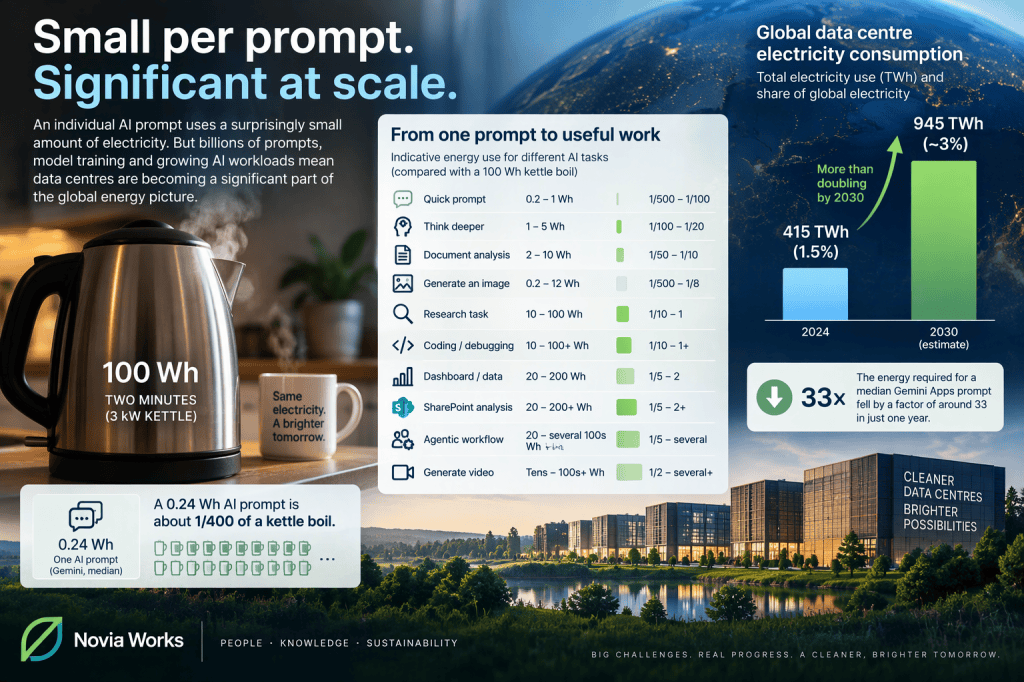
Putting individual tasks into the context of kettle boils shouldn’t be confused with arguing that the overall energy consumption of AI doesn’t matter. The International Energy Agency estimated global data-centre electricity consumption at around 415 TWh in 2024, approximately 1.5% of global electricity consumption, and expects demand to rise substantially as AI infrastructure expands, potentially reaching around 945 TWh by 2030. At that scale, data-centre demand is obviously an important part of electricity-system planning, grid investment and decarbonisation.
Those large system-level figures can coexist quite comfortably with the small per-task numbers. An individual text prompt can consume almost trivially little electricity while billions of interactions, model training, increasingly sophisticated workloads and rapidly expanding data-centre infrastructure collectively consume an enormous amount. Google has reported that the energy required for a median Gemini Apps prompt fell by a factor of around 33 in a year, which shows just how rapidly the underlying technology can become more efficient. If usage expands even faster than efficiency improves, however, total electricity consumption can continue rising.
The energy required for a median Gemini Apps prompt fell by a factor of around 33 in a year
This is a familiar problem in energy efficiency. Making something cheaper and more efficient often means that we use more of it. That’s Jevon’s paradox again. As things get easier or cheaper, we tend to use them more, resulting in no net saving, eroding part or all of the original saving. AI makes activities that were previously time-consuming or expensive so easy that we may undertake many more of them. I certainly create more blogs today than 3 years ago (though there are other factors at work in that). If AI allows me to produce an article in 75 minutes instead of five hours, I could take the remaining time off (and play guitar) and reduce my energy use, but I am at least as likely to use some of it to produce something else. My energy consumption per useful outcome may have fallen while my total consumption remains the same or increases.
Conclusion
The right question is not simply whether AI uses too much energy. Of course it uses energy, sometimes a trivial amount and sometimes a substantial amount. What matters is what we achieve with it, what we would otherwise have done, whether greater efficiency is driving additional consumption, and whether the outcome is worth the resources used to create it. In the case of this article you will have to judge whether it was worth the expenditure; I’m biased.
I would like to see AI providers publish much better information about this. Instead of one generic figure for a prompt, it would be useful to have something approaching an energy label for AI workloads, like we have on home appliances, distinguishing quick text interactions from deeper reasoning, document analysis, images, video, research, coding and agentic workflows. Without that information we can understand the broad scale, but we can’t make particularly good comparisons between services or calculate the footprint of our own AI use with much confidence.
While the 0.24 Wh figure remains a useful starting point, I’m more interested in how much energy the complete AI-assisted process consumed, how much an equivalent non-AI process would have consumed, whether AI genuinely replaced some existing activity or encouraged additional activity, and whether the result was worth the energy used to create it.
One ordinary AI prompt may use around 1/400 of a kettle boil. A substantial AI workflow may use one boil, several boils or more. Globally, billions of those activities add up to a significant new electricity demand, but individually they can also replace hours of other computing and human activity.
The important measure isn’t energy per prompt. It is energy per useful outcome.
And yes, this article used AI to help investigate the energy consumed by using AI. The fact that I can’t yet tell you accurately how many Wh that amounted to is probably a useful conclusion in itself.
Afterword
For completeness, creating this article took 21 prompts, including research, fact-checking, drafting, revisions, and three image generations; then creating this afterword after everything else. Treating them all as ordinary 0.24 Wh text prompts would give just 4.6 Wh, but that clearly understates the more demanding research, reasoning and image-generation work involved.
Using the ranges discussed in the article, I estimate the AI contribution at roughly 15–100 Wh, less than one complete minute kettle boil. I used the time saved to play tennis with my wife, burning 1000 dietary calories, or about 1160 Wh. I would have used less energy writing aother article!
And yes, I burned about 0.24 Wh working that out.
Sources
Google Cloud: Measuring the environmental impact of AI inference
https://cloud.google.com/blog/products/infrastructure/measuring-the-environmental-impact-of-ai-inference
Google Research: Measuring the environmental impact of delivering AI at Google Scale
https://arxiv.org/abs/2508.15734
Microsoft Research: Energy use of AI inference, efficiency pathways, and test-time scaling
https://www.microsoft.com/en-us/research/publication/energy-use-of-ai-inference-efficiency-pathways-and-test-time-scaling/
International Energy Agency: Energy and AI
https://www.iea.org/reports/energy-and-ai/
International Energy Agency: Energy demand from AI
https://www.iea.org/reports/energy-and-ai/energy-demand-from-ai
The Hidden Cost of an Image: Quantifying the Energy Consumption of AI Image Generation
https://arxiv.org/html/2506.17016v1
AI Energy Score
https://huggingface.github.io/AIEnergyScore/
From Efficiency Gains to Rebound Effects: The Problem of Jevons’ Paradox in AI’s Polarized Environmental Debate
https://arxiv.org/pdf/2501.16548v2
Novia Works: AI data centres and 3% of global electricity. Really?
https://noviaworks.co.uk/2025/05/25/datacentrepower/
Hanna Radtke Bergström: LinkedIn article that prompted this article
https://lnkd.in/p/e5gr-uw8


