
From Copilot features to an operating model for AI at work
Microsoft Ignite inevitably produces an enormous collection of announcements. Taken individually, many of the 2026 announcements sound familiar: more Copilot, more agents, more connectors, more security and another collection of things entering preview. When I look at the big picture, however, something more significant seems to be emerging.
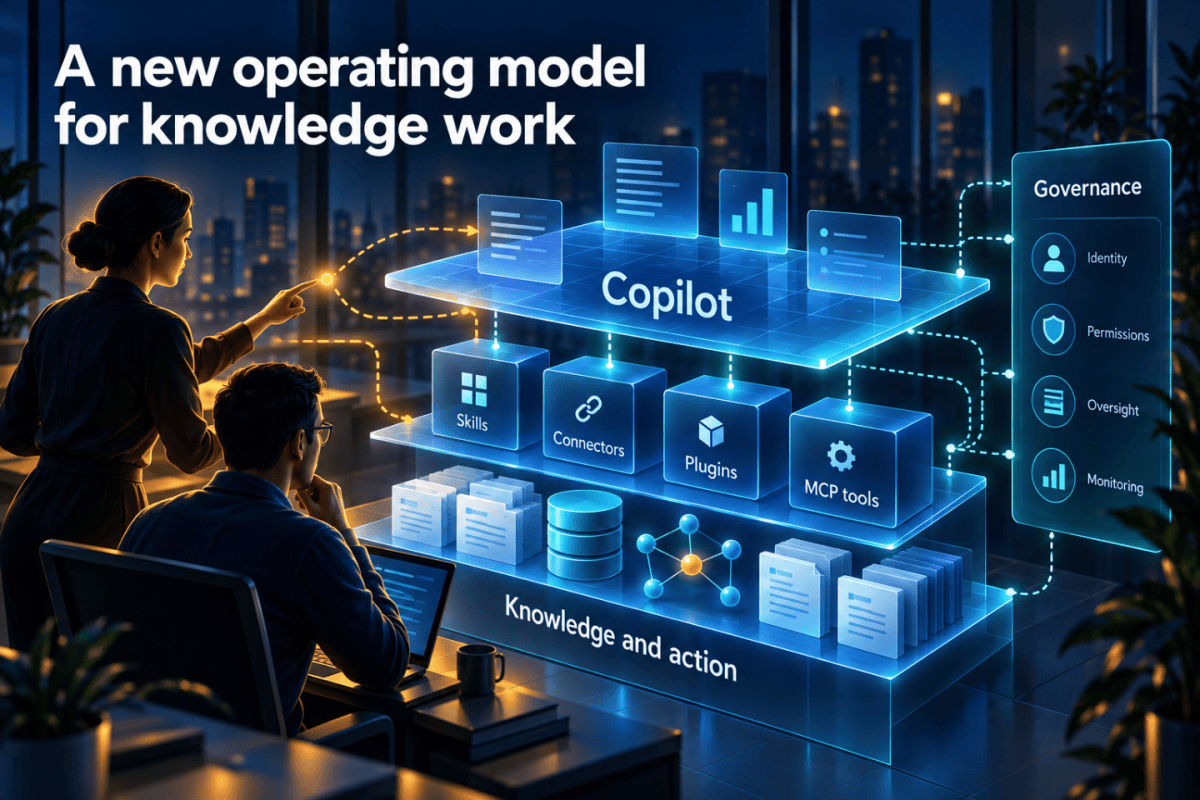
What Microsoft is assembling looks more like a new operating model for knowledge work than a bunch of technologies and features.
It’s not that Copilot is getting ‘better’, rather it describes an architecture in which Copilot increasingly becomes the place from which work is initiated; organisational knowledge and context sit beneath it; capabilities are packaged into reusable skills, plugins and tools; increasingly autonomous agents are given identities and controlled authority; and Agent 365 provides oversight across the resulting agent estate.
There are still some substantial gaps, and quite a lot is in preview. But Ignite 2026 makes the overall direction considerably easier to see.
Listen to the micropodcast version
Copilot as the working surface
Satya Nadella’s claim that Copilot is becoming the “OS for work” deserves some scepticism. Microsoft Office isn’t disappearing and neither are Teams, Outlook or the hundreds of specialist applications organisations depend upon.
The more interesting interpretation is that Microsoft is proposing an inversion of the traditional relationship between applications and assistance. Until recently, you opened an application (or started in SharePoint if you have listen to my concern) and invoked Copilot when you wanted some assistance. Increasingly, Microsoft’s model starts with Copilot and brings applications, data and capabilities to it. This is very much where I am currently, though my motivation is that I do an increasing amount of work on my phone without needing to be near my workstation; Copilot partially eliminates the limitations of the smartphone UI and enables me to work in the moment when inspiration (or need) strikes. I STRONGLY note how frustrating the lack of two way interaction with SharePoint is at present, however
Office in Copilot is now generally available, allowing Word documents, Excel workbooks and PowerPoint presentations to be created and edited alongside the Copilot conversation (though they are frustratingly saved to OneDrive). ‘Home‘ in the Copilot app combines Chat and Cowork. Code creates applications and dashboards. Autopilot takes responsibility for longer-running activities. Workspaces creates a shared environment in which people and agents can work against common context, though have lost a lot of the Copilot Notebook capabilities I was using.
Applications don’t disappear in this model. They increasingly provide specialist capabilities to a higher-level working environment.
It is an ambitious direction, but describing Copilot as the new operating system for work remains ahead of reality. People still have good reasons (and natural human inertia) to live in Outlook, Teams, Word or Excel, and many of the more transformative Copilot capabilities are still previews or Frontier releases.
My interpretation is therefore slightly more cautious: Copilot is trying to become the principal working surface, rather than merely an assistant attached to individual applications.
Whether users actually choose to work that way will be a better measure of success than Microsoft’s terminology.
SharePoint starts to become an action layer
The less glamorous SharePoint announcements are more immediately important, both for me and to underpin this Microsoft strategy.
Microsoft has placed Work IQ underneath the new Copilot architecture. Its job is to provide agents with permission-aware organisational context across the documents, conversations, meetings, relationships and other information that constitute everyday work. This permission issue is, I suspect, what has delayed Copilot being able to usefully act is SharePoint. OneDrive is easy, everything in it is tits so your agent doesn’t have complex permissions etc. to contend with.
SharePoint, however, is where mature organisations do their knowledge work. It has an obvious role in that architecture because so much governed organisational content already resides there. Historically, however, there has been an important asymmetry: Copilot has been considerably better at finding and reasoning over SharePoint content than maintaining it.
That restricts genuinely agentic work as an agent that can discover an outdated policy, explain precisely what needs changing and even produce replacement wording is useful. An agent that can safely update the authoritative document, modify its metadata, preserve its version history and invoke the appropriate approval process actually improves productivity.
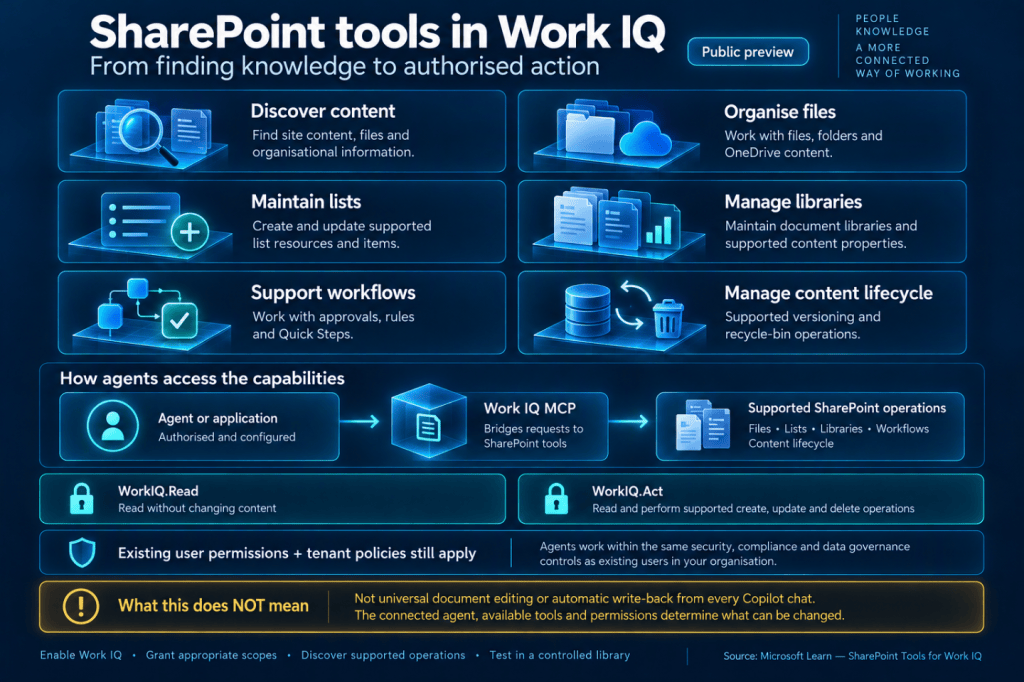
The new SharePoint Tools in Work IQ start to close the SharePoint gap.
They are currently in public preview and expose more than 60 SharePoint operations covering lists and libraries, list items, files and folders, search, approvals, rules, Quick Steps, versioning and the recycle bin. Crucially, Microsoft’s permission model distinguishes between WorkIQ.Read, for retrieval, and WorkIQ.Act, which enables operations that create, modify or delete SharePoint resources. Again, Informative Vs Productive.
Actions operate within the signed-in user’s existing SharePoint permissions, while tenant policy provides another control layer. This is important, it might be unwise to give an AI unrestricted SharePoint access. Rather, it should only allow an agent to perform the same appropriately authorised operations that form part of a person’s work.
Obviously, Work IQ capabilities don’t and mustn’t mean that every Copilot user can immediately tell an ordinary chat session to restructure a document library. Work IQ needs to be enabled, appropriate permissions granted and mutation operations governed. Availability also depends upon the particular agent or application being used.
It fills an important architectural hole, and I’m keen to get my hands on it.
Skills become much more important than prompts
For much of the generative-AI era organisational customisation has centred on prompts: write a particularly good instruction and reuse it. We’ve spent a couple of years training people to do so that.
Skills, plugins, connectors and MCP tools are where we seem to be going next. Combine instructions with access to relevant systems and the operations required to perform work. Ignite’s Salesforce integration provides a good example: Copilotforce arrives with more than 38 pre-built sales skills instead of expecting users to construct every interaction themselves.
Rather than building one enormous agent that knows how to do everything, organisations can assemble capabilities from granular components: a particular skill for a particular type of work, a SharePoint operation when content needs maintaining, a connector for an external system and business knowledge providing the required context. They can write their own, or, I predict, license other managed skills etc.
This should also make organisational AI easier to modify. Change the reusable capability and every appropriate agent doesn’t necessarily have to be redesigned from scratch.
There is a familiar software-engineering principle hiding underneath the AI terminology: loosely coupled, reusable functions are generally preferable to monoliths. The same principle should apply to organisational agents.
Managed agency
Autopilot is notable, both due its potential and because an always-running agent creates a governance problem that an interactive chatbot largely doesn’t.
Microsoft’s answer is identity.
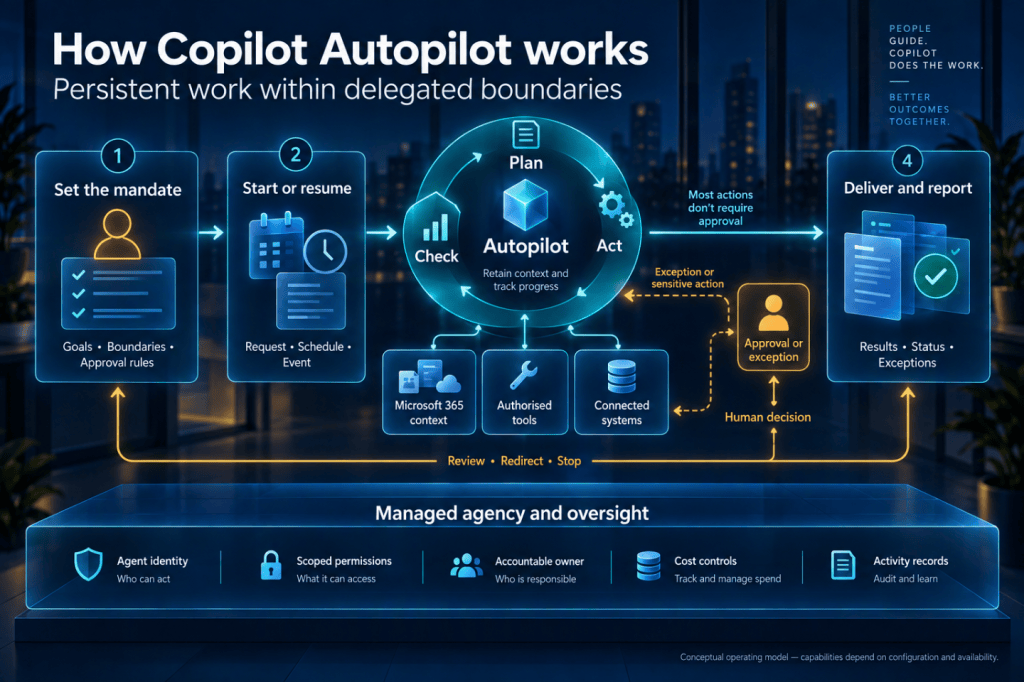
Autopilot is being introduced as a persistent personal agent capable of continuing work without being individually prompted for every action. Importantly, an Autopilot has its own Entra Agent ID. Its activity can therefore be identified as the agent’s activity rather than being indistinguishable from something its human manager did.
As agents become capable of acting rather than merely advising, organisations need to know who or what carried out an operation, what (or whose) authority it was exercising and is therefore accountable for its behaviour.
Organisations need to know who is accountable for an agents behaviour.
Permissions are one part of agency, cost and cost accountability is another. Persistent agents consume resources while acting independently, so budgets, spending limits and cost attribution become governance controls alongside identity and security.
The emerging model might reasonably be called managed agency: giving an agent sufficient authority to perform useful work while retaining explicit identity, boundaries, ownership and accountability.
Agent 365 and managed oversight
That creates another problem. Once an organisation has dozens, hundreds or potentially thousands of agents, managing them individually becomes impractical.
Agent 365 is Microsoft’s answer, and at Ignite Microsoft expanded its positioning from a control plane towards an observability platform covering Microsoft and non-Microsoft agents.
Microsoft Entra Agent ID is expanding to agents from platforms including OpenAI, Anthropic, Salesforce, Google, Databricks and Snowflake. Agent 365 is not simply a management interface for Copilot Studio agents, Microsoft wants it to become the enterprise control plane for an organisation’s wider agent estate.
New capabilities include dynamic agent-risk assessment, multi-tenant management and Business Analytics intended to connect agent consumption with outcomes and expenditure.
There is some sensible caution required here. Measuring an “assisted hour”, for example, isn’t the same as demonstrating that an hour of productive human work has genuinely been saved. Organisations should resist inventing impressive ROI figures from activity metrics. CFOs need to be savvy to that.
Autonomous capability without corresponding observability would be difficult to justify in most enterprise environments. If identity and permissions provide managed agency, Agent 365 provides managed oversight.
Unfinished business
There is an omission in this otherwise increasingly coherent architecture: the precise relationship between people and agents.
Microsoft talks extensively about human ambition and describes Workspaces as a “multiplayer” environment in which people and agents work towards common goals. The demonstrations include approval and review points. That’s welcome, but isn’t the same thing as a mature model for human-agent collaboration.
“Human in the loop” is often used as the reassuring answer to AI autonomy, but I have long maintained that that phrase is too simplistic.
Sometimes a person is directing the process and AI is assisting. Sometimes an agent may perform most of a process and involve a person when judgement, authority or expertise is required. Sometimes human and agent may genuinely collaborate. And sometimes an autonomous agent should complete a well-bounded task without interrupting anyone at all. I’d also argue that there are times when an AI should be in a human loop. Many times.
People can and should be in an agent’s loop and vice versa.
As agents become more autonomous, organisations will need to define not merely what an agent is permitted to do, but who has initiative at each stage, when authority transfers between human and agent, what triggers escalation and how a person takes control back.
Microsoft has given considerably more architectural detail to agent identity, permissions, data access, risk, observability and cost than it has so far given to this interaction model.
That leaves a sixth component still to be developed: managed collaboration.
What organisations should do now
The temptation after an Ignite packed with agent announcements will be to start building agents. The better first step is to prepare the environment in which useful agents can safely operate.
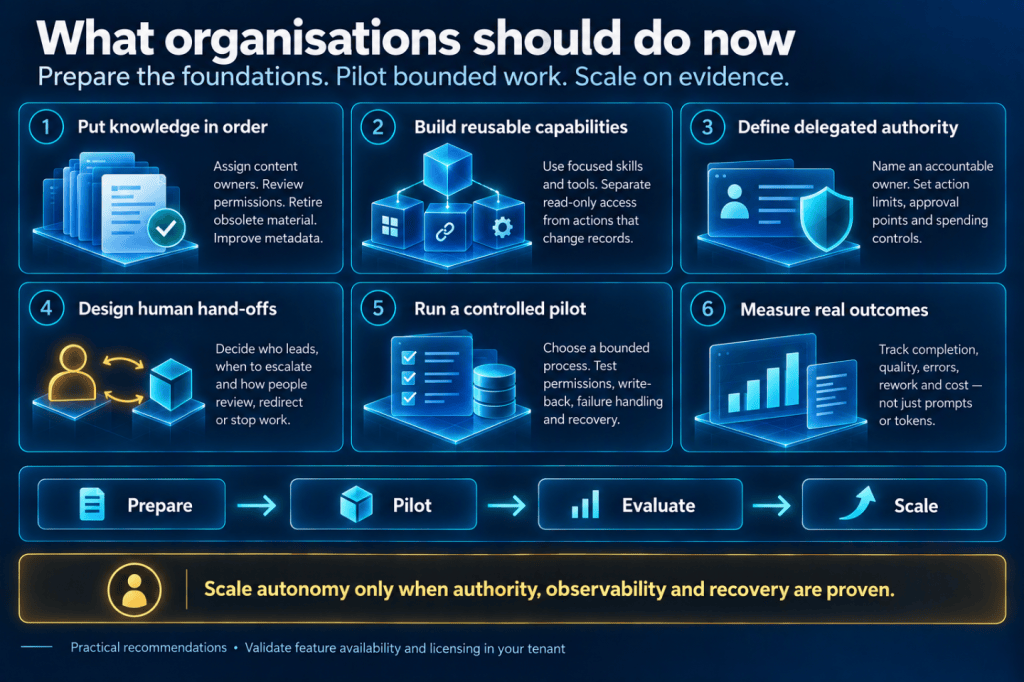
Information architecture matters more rather than less. SharePoint content needs meaningful ownership, permissions, metadata and lifecycle management if it is going to become operational context for AI. Overshared, duplicated or obsolete content doesn’t become good organisational knowledge merely because Work IQ can retrieve it intelligently. ROT will rapidly degrade your agents.
Redundant, Outdated, and Trivial: will ROT your AI
Reusable capabilities should meanwhile be preferred to increasingly elaborate prompt monoliths and organisations need to skill up, literally and figuratively.
Skills, plugins, connectors and MCP tools should have clearly defined purposes and permissions, and organisations should know which of them merely retrieve information and which can change systems of record.
Agents capable of action should have identifiable owners, documented intent and scope, bounded authority and observable activity. Those principles should be established before autonomy is introduced rather than retrofitted after agents have proliferated.
And pilots should evaluate genuine outcomes. Task completion, quality, error rate, rework and consequential business results matter considerably more than prompts submitted, tokens consumed or estimated hours “assisted”.
Finally, organisations should experiment with the human-agent relationship itself. Which work is best human-led, which is agent-led, where does collaboration genuinely improve the outcome? And who watches whom. Technology alone won’t settle those questions.
End thoughts
As ever, Microsoft Ignite 2026 hasn’t delivered this entire future as a finished product. Some of its most interesting components remain preview technologies, Frontier releases or statements of direction. The pieces are beginning to form a recognisable architecture I think.
Copilot becomes the increasingly important working surface. SharePoint and Work IQ provide governed organisational context and an emerging action layer. Skills, connectors, plugins and MCP tools provide granular reusable capabilities. Agent identities, permissions and budgets provide managed agency. Agent 365 provides managed oversight.
What remains less well defined is managed collaboration between the people and agents occupying that environment.
That may turn out to be the harder problem.

Sources
Microsoft Ignite 2026 Book of News
https://news.microsoft.com/events/ignite/2026/book-of-news/
Ignite 2026: Building the frontier ecosystem
https://blogs.microsoft.com/blog/2026/11/17/ignite-2026-building-the-frontier-ecosystem/
Copilot at Microsoft Ignite: Expanding what’s possible with intelligence built for work
https://www.microsoft.com/en-us/copilot/blog/2026/11/17/copilot-at-microsoft-ignite-expanding-whats-possible-with-intelligence-built-for-work/
SharePoint and OneDrive at Microsoft Ignite 2026: Putting AI-powered content to work
https://techcommunity.microsoft.com/blog/spblog/sharepoint-and-onedrive-at-microsoft-ignite-2026-putting-ai-powered-content-to-w/4535416
Introducing SharePoint tools in Work IQ
https://techcommunity.microsoft.com/blog/spblog/introducing-sharepoint-tools-in-work-iq/4569917
SharePoint Tools for Work IQ
https://learn.microsoft.com/en-us/microsoft-365/copilot/extensibility/work-iq/sharepoint-iq
Work IQ: SharePoint Tools
https://devblogs.microsoft.com/microsoft365dev/work-iq-sharepoint-mcp-tools/
What’s new in Microsoft Agent 365: Ignite 2026
https://techcommunity.microsoft.com/blog/agent-365-blog/whats-new-in-microsoft-agent-365-ignite-2026/4571753
Microsoft positions Copilot as a hub for team collaboration
https://www.computerworld.com/article/4250734/microsoft-positions-copilot-as-a-hub-for-team-collaboration.html
Everything Microsoft Announced at Ignite 2026 So Far
https://www.techrepublic.com/article/news-microsoft-ignite-2026-announcements/


