
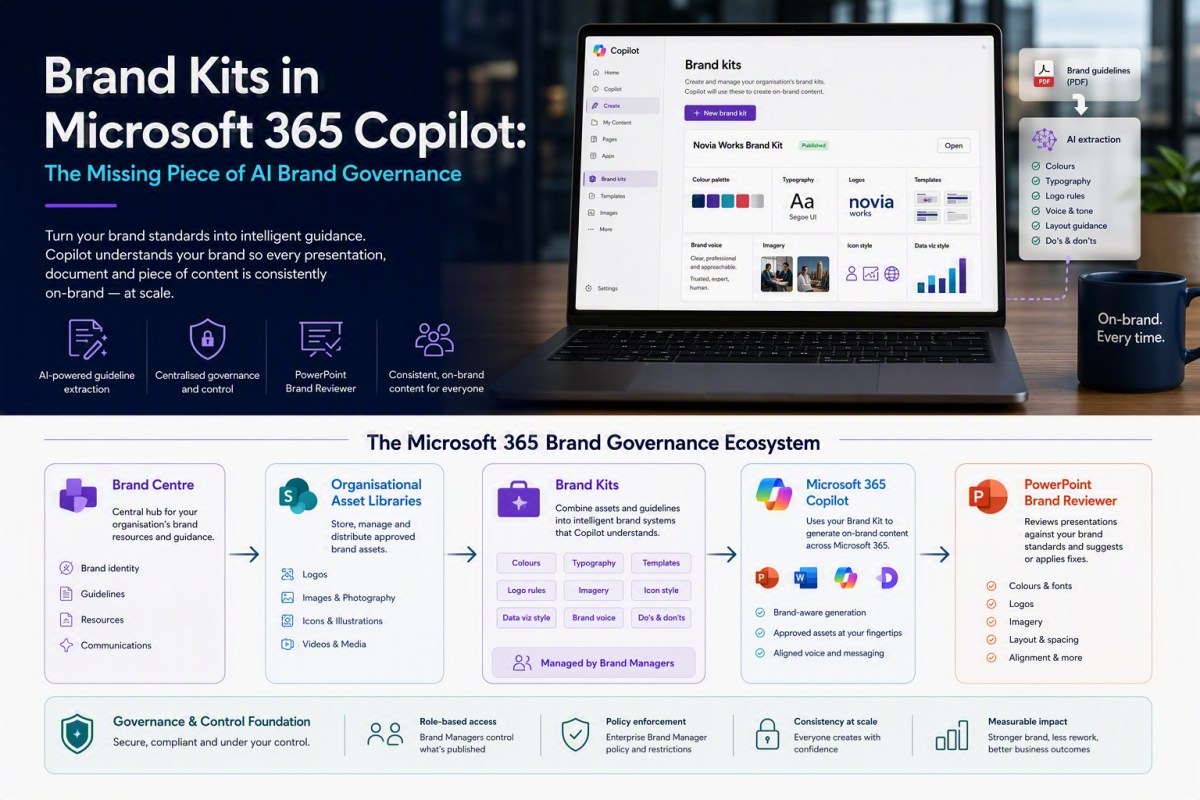
The Missing Piece of AI Brand Governance
Earlier this year, I explored the differences between Microsoft’s Brand Centre and Brand Kit capabilities and explained how they fit together within the Microsoft 365 ecosystem. If you missed that article, it provides useful context because the distinction is becoming increasingly important as Microsoft expands its branding and governance features.
Brand Centre focuses on the management and distribution of approved organisational assets and branding resources. Brand Kits, on the other hand, provide the intelligence that allows Microsoft 365 Copilot and PowerPoint to understand and apply those standards when generating content.
You can read the earlier article here:
Since writing that article, Microsoft has significantly enhanced Brand Kits. What started as a repository for logos, colours and templates has evolved into something much more sophisticated. Brand Kits are now becoming a core governance capability that enables Copilot to generate content that reflects not only your organisation’s visual identity but also its style of communication, brand values and content standards.
For organisations investing in Microsoft 365 Copilot, this matters because one of the most common concerns surrounding generative AI is consistency. Producing content quickly is useful. Producing content quickly while remaining compliant with organisational standards is considerably more valuable.
Why Brand Kits Matter
Most organisations have invested significant effort in developing their brand identity. Colours, typography, imagery, terminology, messaging and tone of voice are carefully defined to create a consistent experience for customers, employees and stakeholders.
Historically, enforcing those standards has relied on a combination of training, templates, review processes and a lot of manual effort. Users needed to remember branding rules, locate the right assets and select the correct templates. In practice, this often led to inconsistent presentations, off-brand documents and unnecessary rework.
As AI-generated content becomes more widespread, that challenge becomes even greater. Without governance, every employee could potentially create dozens of presentations, documents and marketing materials that vary slightly from established standards.
Microsoft’s latest Brand Kit capabilities seek to address this problem by embedding branding guidance directly into the content creation process. Instead of expecting people to remember the rules, Copilot can increasingly apply them automatically. The result is greater consistency, less manual correction and a reduced burden on marketing and design teams.
Automated Extraction of Brand Guidelines
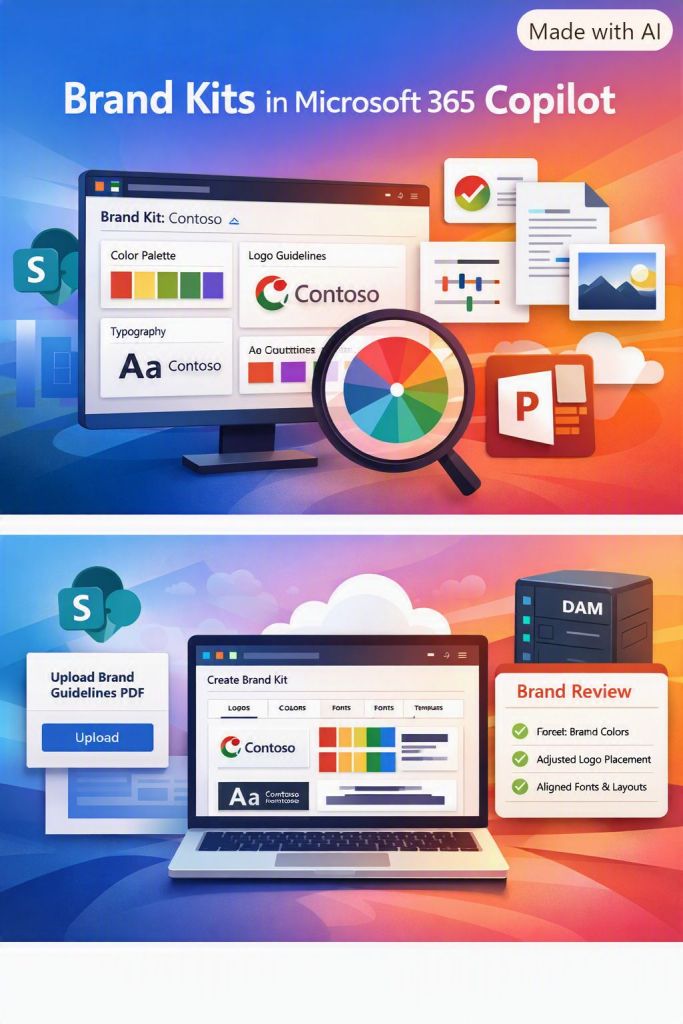
One of the most significant enhancements is the ability to upload a PDF version of your organisation’s brand guidelines and allow Copilot to perform the heavy lifting.
Rather than manually entering colours, fonts, logo rules and writing guidance, Copilot analyses the document and extracts the information it needs. Microsoft states that this can include colour palettes, typography guidance, brand voice, logo standards, visual styling and other branding rules contained within the source document.
This dramatically reduces the effort involved in creating a Brand Kit. Organisations that have already invested in comprehensive brand guidelines can now leverage that investment directly rather than recreating the information manually within Microsoft 365.
Once the extraction process is complete, Brand Managers can review the generated content, make adjustments where necessary and publish the results for wider organisational use. Microsoft notes that extracted values can override existing kit settings, making the review stage particularly important.
From Asset Library to Brand Governance Platform
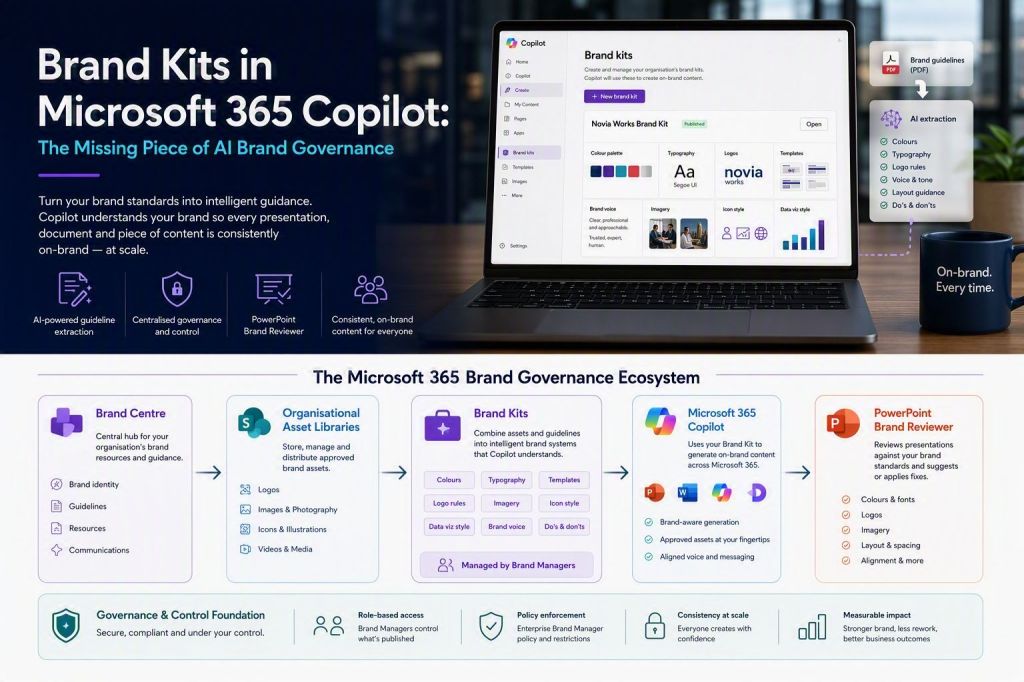
Perhaps the most important change is that Brand Kits are no longer simply collections of files.
Microsoft now describes Brand Kits as containing approved brand elements and guidelines that provide the foundation for on-brand content creation. These can include logos, colour palettes, typography rules, templates, photography guidance, icon sets, data-visualisation styles, brand voice and organisational do-and-don’t rules.
This distinction is important because it changes the role Brand Kits play within the Microsoft ecosystem. Rather than just supplying design assets, they increasingly define the rules that Copilot can use when creating content.
For organisations concerned about AI governance, this is a significant development. It moves Copilot closer to becoming an assistant that understands brand standards rather than simply generating generic content that requires extensive manual refinement afterwards.
Brand Reviewer in PowerPoint
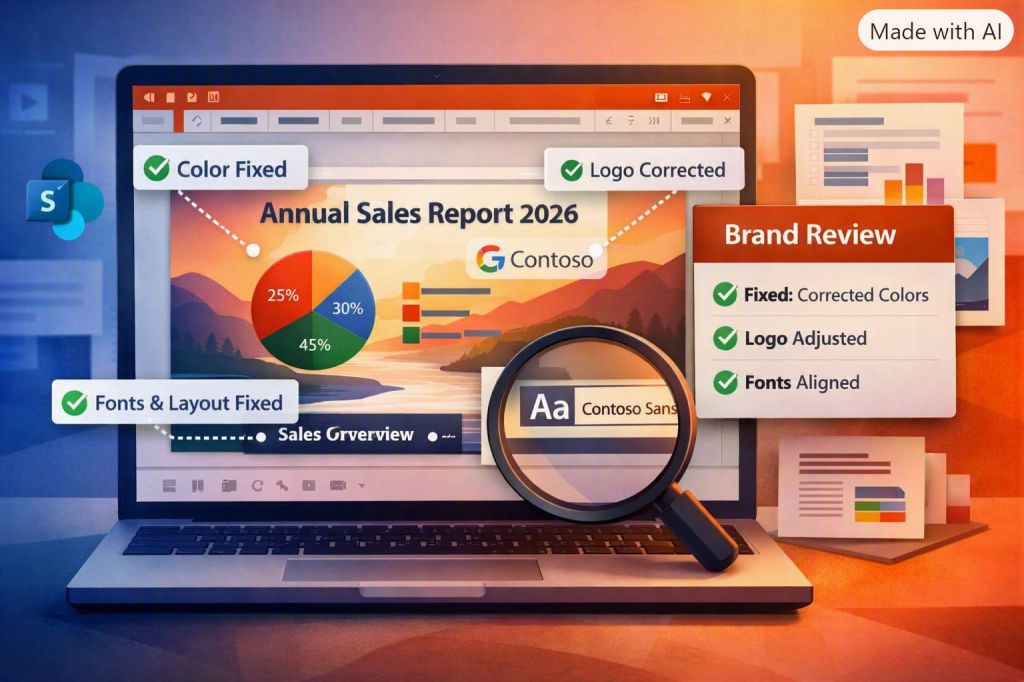
PowerPoint is currently one of the biggest beneficiaries of the Brand Kit enhancements.
Microsoft’s Brand Reviewer capability uses the published Brand Kit to identify potential branding issues within presentations. According to Microsoft, Brand Reviewer can identify problems such as incorrect colours, unsuitable fonts, misplaced logos, off-brand imagery and layout inconsistencies, then suggest corrective actions. [1](https://support.microsoft.com/en-us/Microsoft-365-Copilot/create-and-manage-official-brand-kits-in-the-microsoft-365-copilot-app)
This capability has the potential to remove a significant amount of manual checking from the presentation creation process. Rather than relying solely on design teams or marketing reviewers, users can receive branding guidance directly within PowerPoint while they work.
For organisations producing substantial numbers of customer presentations, proposals or executive decks, this could result in meaningful time savings while simultaneously improving quality and consistency.
Integration with Organisational Asset Libraries
Brand Kits work particularly well when combined with SharePoint Organisational Asset Libraries.
Microsoft’s documentation highlights the ability to surface approved organisational assets directly within Microsoft 365 Copilot experiences. This allows users to access centrally managed logos, images, illustrations and other approved resources without searching multiple repositories or maintaining local copies.)
This integration also reinforces an important point made in my earlier Brand Centre versus Brand Kit article. The two capabilities are not competing solutions. Instead, they work together.
Brand Centre and Organisational Asset Libraries provide the managed content. Brand Kits provide the rules and guidance that determine how those assets should be used.
Together they form a much stronger governance model than either capability delivers independently.
Governance and Administration
Microsoft has taken a deliberately controlled approach to Brand Kit administration.
While published Brand Kits can be consumed broadly across an organisation, official Brand Kits can only be created, edited and published by designated Brand Managers. Microsoft requires organisations to establish a mail-enabled security group and enable the Enterprise Brand Manager policy before users gain access to these management capabilities. Microsoft also notes that permission changes can take time to propagate through the service.
This separation between consumption and administration is sensible. Most organisations will want brand governance to remain under the control of marketing, communications or designated governance teams rather than allowing unrestricted modification of corporate branding standards.
It is also worth noting that Microsoft has introduced options to restrict Brand Kit creation to specific groups, allowing organisations to maintain tighter governance over branded asset creation where required.
Real-World Scenarios
The practical value of Brand Kits becomes clearer when viewed through real business scenarios.
A sales team preparing a customer proposal can use Copilot to generate a first draft presentation that already aligns with approved branding standards. Rather than spending time searching for logos, colours and templates, users can focus on refining the message.
Professional services teams can create reports and customer deliverables that follow established presentation and communication standards even when produced by individuals who are not design specialists.
Marketing departments can use Brand Reviewer as an additional quality control mechanism, helping to identify branding issues before content reaches customers or stakeholders.
Senior leadership teams gain greater confidence that AI-generated content remains aligned with organisational standards, reducing concerns that widespread Copilot adoption will result in inconsistent messaging or visual identity.
These are precisely the scenarios where governance and productivity come together most effectively.
Current Limitations
The feature set is maturing rapidly, but there are still some limitations worth understanding.
Microsoft currently supports only a single guideline PDF within each Brand Kit. Replacing the document requires removal of the existing guideline source. Microsoft also advises that guideline uploads can overwrite previously configured branding information, making governance and change control important considerations for larger organisations. Processing times vary based on document size and complexity and may take several minutes to complete.
Additionally, official organisational Brand Kits remain dependent on the Brand Manager governance model, meaning organisations must complete the necessary administrative configuration before these capabilities become available.
Conclusion
Over the past year Microsoft has steadily been building the governance foundations required for enterprise AI adoption. Brand Kits are an important part of that journey.
The latest enhancements move Brand Kits far beyond simple collections of logos and templates. They are increasingly becoming a mechanism through which organisations can encode brand standards, design principles and communication guidance directly into Microsoft’s AI-powered productivity tools. Automated guideline extraction, integration with organisational asset libraries and PowerPoint’s Brand Reviewer all point in the same direction: a future where AI-generated content is expected to be on-brand by default rather than corrected after the fact.
For organisations deploying Microsoft 365 Copilot at scale, Brand Kits should no longer be viewed as a marketing feature. They are rapidly becoming a core governance capability that helps ensure AI-generated content remains aligned with organisational identity, communication standards and brand values. As Microsoft continues to invest in enterprise AI governance, I expect Brand Kits to become a foundational component of any serious Microsoft 365 Copilot implementation.


One reply on “More on Brand Kits in Microsoft 365 Copilot:”
[…] then revisited the subject in More on Brand Kits in Microsoft 365 Copilot, looking at the growing role of Brand Kits, Brand Reviewer and Copilot-supported content […]