
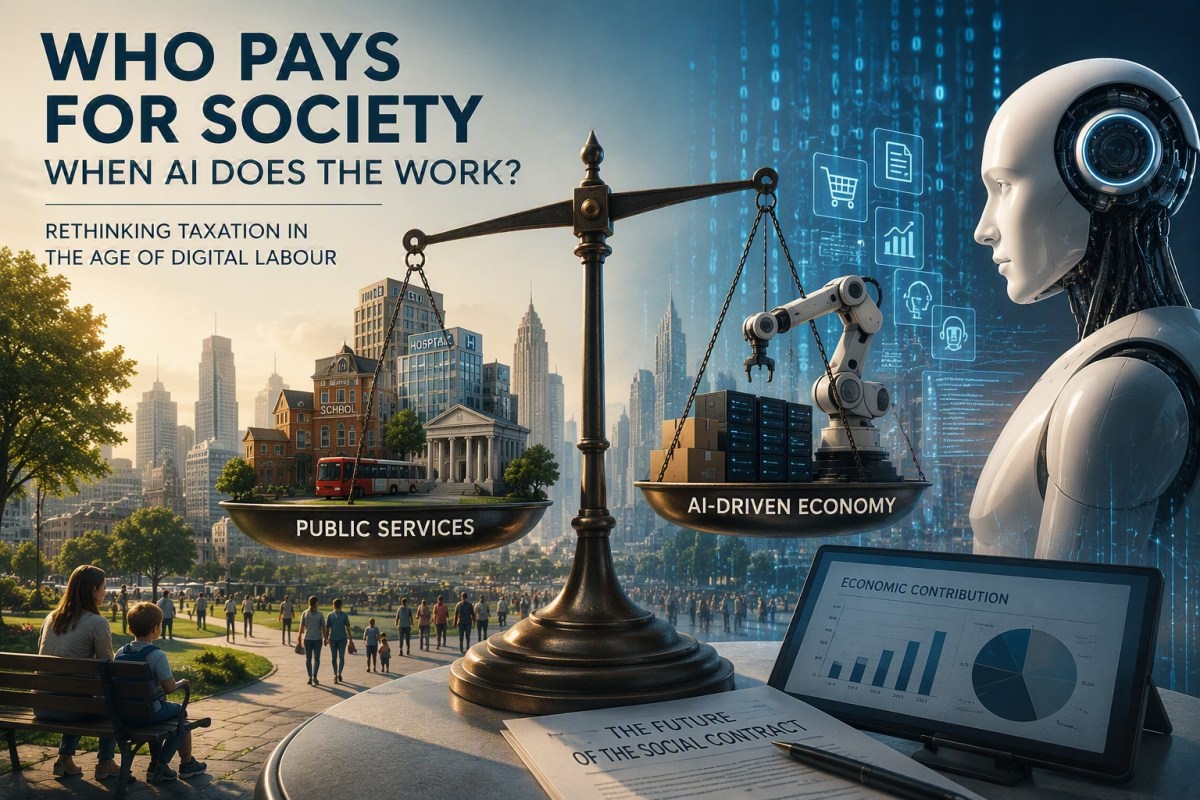
Every generation inherits institutions designed for the economic realities of its own age. The taxation systems that underpin most modern societies emerged from a world in which productive work and human labour were fundamentally inseparable. Whether a nation relied upon agriculture, manufacturing, services or knowledge work, economic value was largely created by people. Businesses employed workers, workers earned wages and governments collected taxes from those earnings to fund public services, infrastructure, education, healthcare and the countless institutions that make modern societies function. While technologies have continually improved productivity, the underlying relationship between labour and taxation has remained remarkably stable. Human beings worked, and the economic activity generated by that work funded society itself.
The rise of agentic artificial intelligence has the potential to challenge that relationship more profoundly than any previous technological development.
Much of the public conversation surrounding AI focuses on efficiency, productivity and economic growth. Governments speak enthusiastically about international competitiveness. Technology companies describe a future in which autonomous systems eliminate administrative burdens and enable organisations to achieve levels of productivity that would previously have been unimaginable. Business leaders see opportunities to increase capacity, improve customer service and reduce operating costs. The prevailing assumption is that increased productivity is inherently beneficial and that society will adapt, as it has adapted to previous waves of technological change.
History certainly offers grounds for optimism. The industrial revolution eliminated many forms of manual labour but created entirely new industries. Mechanisation transformed agriculture while freeing millions of people to work in manufacturing and services. Computers removed countless clerical tasks yet generated entirely new professions. Each major technological shift disrupted existing employment patterns but ultimately expanded economic output and created new opportunities. For this reason, some commentators dismiss concerns about AI-driven job displacement as merely the latest chapter in a long history of technological anxiety.
Yet agentic AI differs from previous technologies in one potentially significant respect. Most historical innovations automated specific tasks. Agentic systems increasingly automate the decision-making, coordination and cognitive activities that underpin entire categories of work. They are not merely making employees more productive; they are beginning to perform functions that were previously inseparable from employment itself. Whether they eventually replace large numbers of jobs remains uncertain, but the possibility raises an important question that receives far less attention than it deserves. If a growing proportion of economically valuable work is performed by software rather than people, how will societies continue to fund the public institutions upon which their prosperity depends?

The Tax System Was Designed for Human Labour
This is not primarily a technology question. It is an economic and political question. More fundamentally, it is a question about the future of the social contract.
Modern societies operate on an implicit bargain. Businesses benefit from functioning infrastructure, educated workforces, legal protections and public stability. Citizens benefit from employment opportunities, public services and economic participation. Taxation serves as the mechanism through which a portion of privately generated wealth is returned to society for collective benefit. The precise arrangements vary between countries, but the basic principle remains consistent. Those who participate in and benefit from the economy contribute towards sustaining the institutions that support it.
For more than a century, employment has been one of the primary channels through which this contribution occurs. In the United Kingdom, for example, income tax and National Insurance contributions remain major sources of public revenue. Beyond direct taxation, employment generates consumer spending, pension contributions, local economic activity and wider fiscal benefits. When people work, governments receive revenue not only from their earnings but from the economic ecosystem that surrounds them.

When Productivity Becomes Detached from Employment
Imagine, however, a future in which a significant proportion of administrative, analytical, customer service and operational work is carried out by autonomous agents. A company that once employed one thousand people may be able to achieve a similar level of output with six hundred employees supported by thousands of digital workers. The organisation may become more productive and more profitable. Customers may receive better service. Economic output may increase. Yet the flow of tax revenue linked directly to employment could decline.
The challenge here is subtle but important. The problem is not that society becomes poorer. Indeed, automation may make society considerably wealthier. The challenge is ensuring that the mechanisms by which wealth is returned to society evolve alongside the mechanisms through which wealth is created.
The economic success of the twentieth century rested on a broadly reliable assumption that growth and employment would move together. Businesses expanded by hiring people and governments collected more revenue because more people were employed. Agentic AI introduces the possibility, at least in some sectors, that growth and employment may become partially decoupled. If organisations can dramatically increase output without proportionately increasing headcount, then conventional assumptions about how prosperity funds public services begin to look less certain.

The Seductive Simplicity of a Robot Tax
This distinction is often lost when discussions turn towards the idea of taxing robots or AI systems. The concept is appealing because it appears intuitive. If machines replace workers, then perhaps machines should be taxed like workers. The argument gained prominence several years ago when proposals emerged suggesting that companies deploying automation technologies should pay taxes equivalent to those that would previously have been paid by displaced employees.
At first glance, the idea possesses a certain elegance. If technology reduces payroll costs, the resulting savings could be partially redirected towards maintaining public services. However, once examined in detail, the concept becomes surprisingly difficult to implement. What exactly constitutes a digital worker? Is an AI assistant equivalent to an employee? What about a workflow automation, recommendation engine or planning system? One organisation may deploy a single highly capable agent that performs the work of hundreds of people, while another may employ thousands of specialised agents, each carrying out only a narrow task. Counting agents quickly becomes as arbitrary as counting lines of software code.
More importantly, taxing automation directly risks creating perverse incentives. Throughout history, societies have generally benefited when businesses become more productive. Mechanisation, electrification and digitisation all increased productivity and living standards. A taxation system that penalises technological improvement too aggressively could unintentionally discourage innovation, reducing the very economic growth that ultimately funds public services.
Perhaps We Are Taxing the Wrong Thing
A more promising approach may involve shifting attention away from labour and towards value creation itself.
Much of the current debate assumes that employment remains the most appropriate place from which governments should collect revenue. Yet if autonomous systems increasingly contribute to wealth creation, we may need to ask whether that assumption remains valid. Instead of trying to preserve a model designed for industrial-age labour, policymakers may need to focus on where value is actually being generated in an AI-enabled economy.
This reframes the debate entirely. The question ceases to be whether machines should pay tax and becomes whether public finance systems should continue to depend so heavily upon employment taxes when economic value may increasingly originate elsewhere.
From Taxing Workers to Taxing Value
This would represent a profound philosophical transition. Modern taxation systems are heavily influenced by an industrial-age view of economic activity in which labour serves as the primary source of value. Yet if AI enables extraordinary increases in productivity, value creation may become increasingly detached from human effort. In such a world, continuing to focus taxation primarily on labour may become progressively less rational.
Instead, governments might place greater emphasis on taxing the economic gains generated by automation. Corporation tax, for example, already operates on this principle. If automation allows organisations to generate higher profits, governments can capture a portion of those profits regardless of whether the work was performed by humans or machines. Similar approaches might focus on productivity gains, economic rents or other measures of value creation rather than attempting to classify individual technologies.
Such a transition would not be unprecedented. Tax systems have continually evolved alongside economic structures. Agricultural societies taxed land. Industrial societies increasingly taxed wages and production. Information economies introduced taxes on intellectual property, financial transactions and digital services. There is no reason to assume that future economies must continue to rely upon precisely the same taxation mechanisms that were developed for the industrial era.
The Case for an Automation Dividend
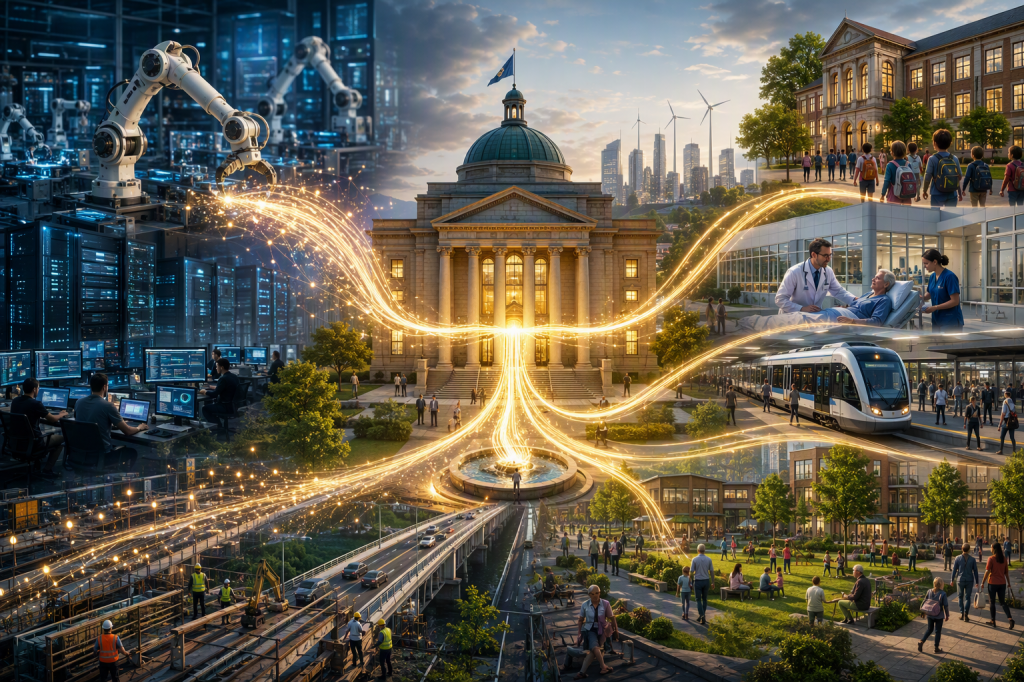
Another possibility is the emergence of what might be described as an automation dividend. The basic logic is that if AI creates extraordinary increases in productivity, some portion of those gains should be returned to society as a whole. Rather than taxing individual agents, governments could establish mechanisms through which profits arising from large-scale automation contribute directly to public investment.
This concept treats automation not as a threat to public finances but as an opportunity. If society becomes substantially more productive, then society as a whole should benefit from that improved productivity. The challenge lies not in preventing automation but in ensuring that some of the resulting gains are reinvested into the communities and institutions that make economic growth possible.
Should Society Own a Share of AI Success?
This idea becomes particularly interesting when viewed through a historical lens. Modern AI systems are not products of private enterprise alone. They are built upon decades of publicly funded research, educational systems, telecommunications infrastructure and scientific advancement. They are trained using knowledge, language and information accumulated across entire societies. One could therefore argue that society itself has already made a significant contribution to the creation of AI and is entitled to share in the benefits that result.
This line of thinking leads naturally towards the concept of sovereign AI funds or national productivity funds. Countries such as Norway have used revenues from natural resources to create investment funds that benefit both present and future generations. AI may eventually be viewed in a similar light. Rather than treating increased productivity purely as a source of private profitability, governments could capture a proportion of AI-enabled economic gains and invest them on behalf of society as a whole. The resulting revenues could support infrastructure, education, healthcare, research and social resilience.
Critics are likely to object that such approaches amount to little more than new forms of taxation. In one sense, they are correct. Yet the deeper issue is not taxation itself. It is ensuring that the distribution of economic benefits remains aligned with societal stability.
Lessons from Previous Industrial Revolutions
Historically, significant technological transitions have occasionally produced periods of extreme inequality before institutions adapted. The industrial revolution generated remarkable prosperity, but also periods of severe social upheaval. Labour laws, public education, workplace protections and modern taxation systems emerged partly in response to the imbalances created by rapid economic change. Few people today would argue that industrial society could function effectively without the institutions that eventually developed to moderate its excesses.
Agentic AI may ultimately require a similar period of institutional innovation. The objective should not be to prevent technological progress, nor to guarantee that every existing job survives unchanged. Such goals would be unrealistic and arguably undesirable. Productivity growth remains one of the most powerful drivers of rising living standards. The challenge is ensuring that the benefits of that productivity are broadly shared.
The Real Question Is Not Taxation
The most important question is therefore not whether AI should be taxed. It is whether societies can successfully separate the concept of public contribution from the concept of employment. For generations, the two have been closely connected. Many people contribute to society principally through work, and societies fund themselves largely through taxing that work. If productive activity increasingly shifts towards autonomous systems, new mechanisms may be required to maintain that connection between economic success and societal contribution.
The debate becomes considerably more interesting when viewed through this lens. It is no longer a question of balancing budgets or creating new tax categories. Instead, it becomes a discussion about the future relationship between productivity, prosperity and citizenship.

Rewriting the Social Contract
Viewed in this light, the debate surrounding AI taxation is not really about technology at all. It is about citizenship, fairness and the future distribution of prosperity. Artificial intelligence may dramatically increase humanity’s productive capacity. It may allow societies to solve problems that have remained stubbornly resistant to traditional approaches. It may create enormous wealth. The critical question is whether the institutions that govern that wealth evolve quickly enough to ensure that the benefits extend beyond the owners of the technology itself.
The social contract has never been static. It has evolved repeatedly in response to changing economic realities. The emergence of mass education, welfare systems, public healthcare and modern taxation were all responses to transformations in how societies generated wealth. The age of artificial intelligence may demand a similar evolution.
A Question for the Century Ahead
The history of economic development suggests that societies are capable of adapting. Taxation systems have changed repeatedly in response to new forms of value creation. New industries have emerged, old industries have disappeared and governments have adjusted accordingly. There is every reason to believe that the same will happen again.
The difference this time is that the conversation needs to begin before the transformation is complete. Waiting until public finances, employment patterns and social expectations have already been disrupted would be a profoundly reactive approach. Instead, policymakers, economists, technologists and business leaders should begin asking difficult questions now.
Not because AI threatens society, but because it may transform it so successfully that the economic assumptions underpinning modern taxation no longer hold.
The defining challenge of the age of artificial intelligence may therefore be neither technical nor computational. It may be political. As digital labour becomes increasingly capable of generating economic value, societies must determine how that value continues to support the institutions, communities and citizens that made its creation possible.

Conclusion: Beyond Taxing Machines
In the end, the question is not whether agents will pay taxes.
The question is how societies ensure that the extraordinary wealth created by artificial labour continues to fund the common good.
The debate over AI taxation is therefore merely the visible surface of a much deeper discussion. Beneath it lies a fundamental question about the nature of prosperity itself. If future wealth is increasingly generated by systems that do not earn wages, buy homes or pay income tax, society must discover new mechanisms through which economic success contributes to collective wellbeing.
History suggests that we will eventually find those mechanisms. The more important question is whether we begin designing them before the need becomes urgent. The societies that navigate the transition most successfully are unlikely to be those that resist automation. Rather, they will be those that find ways to ensure that the benefits of automation remain connected to the communities that helped make it possible.
That, more than taxation alone, may become one of the defining public policy challenges of the twenty-first century.


