
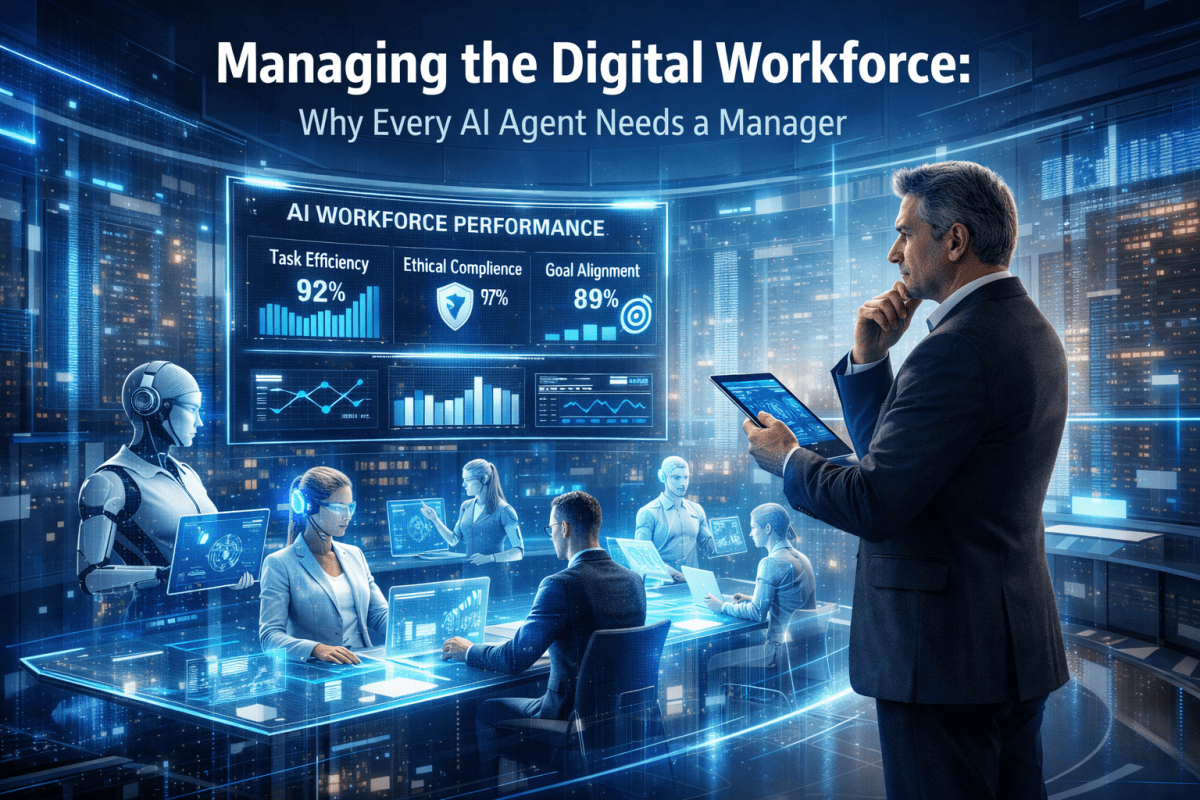
Why Every AI Agent Needs a Manager
For most of the modern corporate era, organisations have operated on a simple assumption. People perform work and technology supports them. Human beings make decisions, exercise judgement, take responsibility and are held accountable for outcomes. Systems, applications and software tools provide information, facilitate communication and automate routine tasks, but ultimately remain subordinate to human direction. This distinction has been so fundamental that businesses have built entirely separate disciplines around managing people and managing technology. Human Resources governs recruitment, development, performance and organisational culture. Information Technology governs infrastructure, software, security and data. The boundaries have been clear because the subjects being governed have been fundamentally different.
The emergence of agentic artificial intelligence challenges that separation in ways that many organisations have yet to fully appreciate.
Much of the current discussion surrounding AI governance remains rooted in the language of software management. Organisations focus on cybersecurity risks, access controls, compliance frameworks, model safety, prompt engineering and responsible AI principles. These issues are undeniably important, but they are increasingly insufficient because they assume that AI remains fundamentally a tool. Historically, tools have been passive. They have no initiative of their own. They cannot interpret objectives, create plans or independently determine the sequence of actions required to achieve a goal. Even highly sophisticated business applications have generally functioned as systems waiting for human instruction.
Agents aren’t software
Agentic AI changes that model completely. Modern agents can analyse objectives, determine appropriate courses of action, interact with multiple systems, retrieve information, communicate with users, invoke other agents and execute increasingly complex workflows with limited human intervention. In practical terms, they are beginning to perform work that would previously have been assigned to a member of staff. The challenge therefore ceases to be one of software governance alone. Instead, organisations find themselves confronting a new management problem: how should they govern entities that are not human, yet increasingly occupy roles once performed by humans?
The answer may be surprisingly straightforward. Rather than viewing AI agents as advanced software applications, organisations should begin treating them as members of a digital workforce.
This does not imply that agents possess consciousness, rights, emotions or moral agency. They are not people and should never be confused with people. However, from an organisational perspective, they are becoming economic actors within the enterprise. They consume resources, perform tasks, make recommendations, take actions and influence outcomes. They create value, generate risk and require oversight. In many respects they resemble employees far more closely than they resemble traditional software systems.
A useful thought experiment is to imagine how most organisations currently introduce AI agents. A team identifies a potential use case, builds an agent, grants it access to relevant systems and deploys it into production. Some monitoring may be established and the project is broadly considered complete. If we applied the same process to recruiting a human employee, most executives would consider it reckless. No responsible organisation would hire an individual without defining their role, clarifying their responsibilities, assigning a manager, setting expectations and establishing a mechanism for performance review. Yet organisations routinely deploy autonomous agents with precisely this level of ambiguity.
This reveals one of the greatest weaknesses in current approaches to AI governance. We have focused heavily on technical controls while largely ignoring management controls.
The Management Toolkit We Already Possess
A common objection to the idea of managing AI agents like employees is that agents are not people. That is obviously true. However, organisations have spent more than a century developing processes for governing autonomous actors who make decisions, perform work, create risk and consume resources. Many of the challenges posed by agentic AI are therefore not entirely new. The difference lies in the nature of the worker rather than the nature of the governance problem. Before inventing entirely new management disciplines, it is worth recognising how many existing processes can be adapted to govern a digital workforce.
| Human Staff Process | Agent Equivalent | Governance Purpose |
|---|---|---|
| Workforce planning | Agent portfolio planning | Ensures organisational capacity aligns with strategic objectives. |
| Recruitment approval | Agent business case and deployment approval | Confirms a genuine business need and acceptable level of risk. |
| Job description | Agent charter and operating scope | Defines responsibilities, objectives and boundaries. |
| Employment contract | Permissions, authority and operational boundaries | Clarifies what actions the worker is authorised to perform. |
| Security vetting | Access review, data classification and risk assessment | Protects sensitive information and reduces organisational risk. |
| Induction and onboarding | Configuration, knowledge grounding and tool assignment | Equips the worker with the resources needed to perform their role. |
| Training and development | Prompt refinement, model updates and capability enhancement | Improves effectiveness and maintains relevance over time. |
| Probation period | Controlled pilot deployment with enhanced monitoring | Validates capability before granting full operational authority. |
| Line management | Named accountable owner or Agent Manager | Provides oversight, accountability and continuous supervision. |
| Delegation of authority | Agent autonomy limits and escalation rules | Controls what decisions may be taken independently. |
| KPIs and objectives | Success metrics, service levels and business outcomes | Measures whether the worker is delivering expected value. |
| Performance reviews | Operational audits and effectiveness reviews | Evaluates results, identifies issues and supports improvement. |
| Coaching and mentoring | Prompt optimisation and workflow improvement | Addresses weaknesses and improves performance. |
| Whistleblowing and reporting | Exception detection and governance alerts | Provides visibility of risks, failures and unexpected behaviours. |
| Disciplinary processes | Restriction, suspension or rollback of capabilities | Limits harm and restores control following unacceptable behaviour. |
| Change of role | Expanded permissions or revised objectives | Aligns responsibilities with changing business requirements. |
| Promotion | Greater autonomy and broader authority | Rewards proven capability with increased responsibility. |
| Succession planning | Migration to new agent architectures | Maintains continuity while adopting improved capabilities. |
| Leave or suspension | Temporary disablement or isolation | Allows risk management without permanent removal. |
| Retirement and offboarding | Decommissioning, archiving and removal of permissions | Eliminates unnecessary risk and reduces operational complexity. |
| Internal audit | Agent observability, monitoring and compliance reviews | Provides assurance that governance controls remain effective. |
The comparison is not perfect, but it illustrates an important point. Organisations already know how to create accountability, define responsibilities, monitor performance and manage risk. The emergence of agentic AI does not require those principles to be abandoned. If anything, it makes them more important. The challenge is not to create a completely new discipline, but to adapt the management practices that have governed human work for generations so that they are equally effective for a workforce that increasingly includes digital workers.
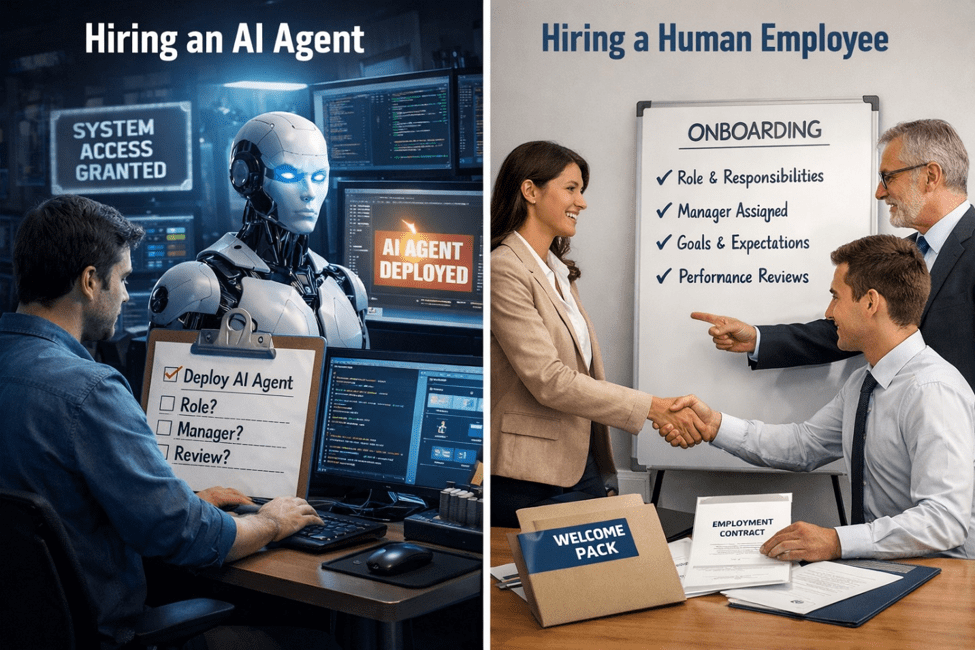
Agents or staff?
The first thing every organisation does when employing someone is create a job description. The document defines why the role exists, what it is expected to achieve, where its authority begins and ends, how success will be measured and who is accountable for supervising it. Such documents are often treated as administrative necessities, yet they serve an essential governance purpose. They provide clarity not only for the employee but for the organisation itself.
AI agents require exactly the same discipline.
Every production agent should possess a clearly documented charter. This charter should define its purpose, objectives, permissions and constraints. It should identify the business outcomes the agent exists to support, the systems it may access, the actions it is authorised to perform and the situations in which it must escalate to a human. Most importantly, it should identify a named owner who remains accountable for the agent’s operation.

Managing the line
This is where the concept of an Agent Manager becomes particularly valuable.
In traditional organisations, managers are not expected to observe every action undertaken by their teams. They provide direction, establish priorities, monitor performance, support development and intervene when problems occur. Their responsibility is one of oversight rather than participation. The same principle should apply to AI agents. Every significant agent should have an accountable manager responsible for reviewing activity, assessing outcomes, managing risk and continuously improving performance.
Such a role should not be confused with the often-discussed idea of a human in the loop. Human-in-the-loop models assume that people must review individual decisions before actions are taken. While this may remain appropriate for high-risk scenarios, it becomes impractical as agent adoption scales. An organisation operating thousands of agents cannot establish a manual approval process for every action. What it can do is apply management disciplines analogous to those already used for supervising human teams. The manager does not approve every decision. Instead, they remain accountable for the outcomes of the system under their care.
This distinction becomes increasingly important as AI agents become more autonomous. Many governance discussions focus on preventing agents from making mistakes. While understandable, this objective is unrealistic. Human employees make mistakes and organisations do not respond by eliminating all employee discretion. Instead, they establish controls, training, supervision and review processes designed to manage risk while preserving productivity. Agent governance should follow the same logic.
The parallel extends beyond management structures into the entire lifecycle of an agent. Before deployment, an agent should undergo an approval process equivalent to recruitment. The organisation should establish a business case, assess potential risks and determine whether the proposed role delivers genuine value. Early deployment should resemble a probationary period, during which authority remains limited and performance is closely monitored. As confidence increases, responsibilities can expand. New capabilities may be introduced, permissions extended and objectives revised in response to organisational needs.
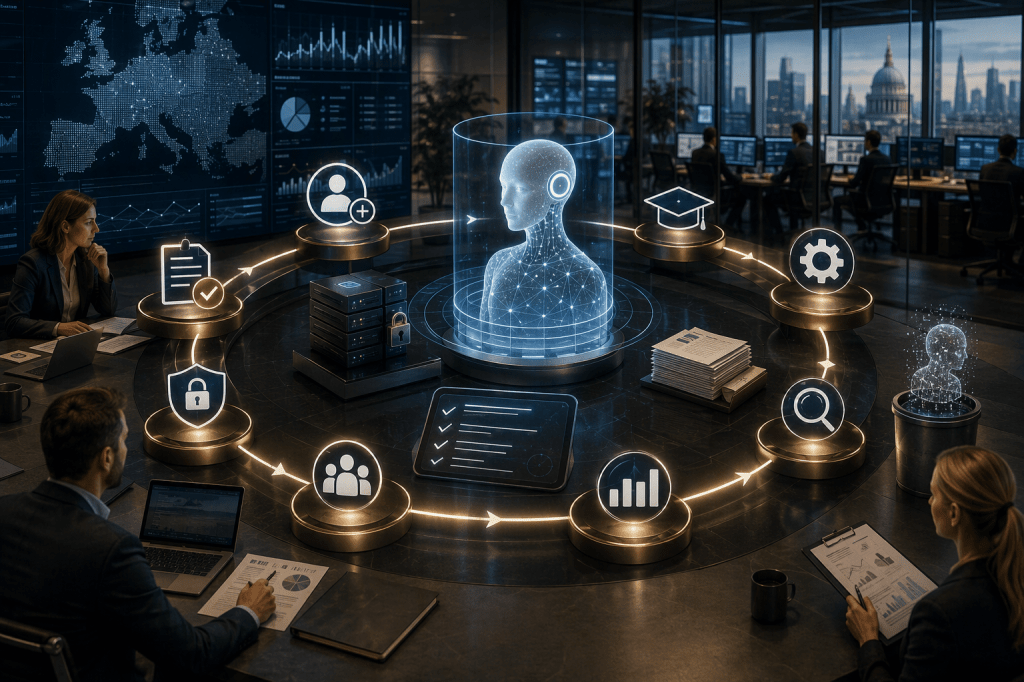
Annual (Agent) Appraisal
Perhaps the most overlooked aspect of agent governance is performance management. Today’s AI discussions are dominated by security, compliance and technical reliability. Yet businesses do not employ people simply because they comply with policies or avoid security incidents. They employ people because they deliver value. The same principle applies to agents.
An agent that operates securely but generates little benefit remains a poor investment. Organisations therefore need mechanisms for assessing the effectiveness of digital workers. Measures may include productivity, quality, accuracy, customer satisfaction, cost efficiency, compliance performance and business outcomes. Regular reviews should consider not only whether the agent remains safe, but whether it continues to justify its existence. Some agents may require retraining, redesign or reassignment. Others may reach the end of their useful life and require retirement.
This concept of retirement is itself instructive. Traditional software is rarely treated as something with a career lifecycle. Applications are upgraded or replaced, but seldom managed in the same structured way as employees. Agents, however, increasingly possess organisational identities, responsibilities and performance histories. Retiring an agent may involve transferring knowledge, revoking permissions, archiving activity records and redistributing responsibilities. Once again, the parallels with workforce management become difficult to ignore.
There are, of course, limits to this analogy. Agents do not experience motivation, wellbeing, ambition or job satisfaction. They cannot be inspired by leadership or discouraged by organisational change. Unlike people, they bear no moral responsibility for their actions. This distinction is critical because it underscores a principle that should remain at the heart of all AI governance: accountability can never be delegated to the machine. Agents may perform work, but responsibility remains with people. Organisations should resist any temptation to treat autonomous systems as independent actors in a legal or ethical sense. Managers, executives and owners remain accountable for outcomes regardless of how much work is delegated to digital systems.
Final thoughts
Despite these limitations, the workforce analogy offers a powerful framework for the future of organisational governance. The most successful enterprises of the next decade are unlikely to view AI purely as technology. They will view it as a new category of labour. Their organisational charts may eventually include human employees, contractors and digital workers operating side by side. Managers may become responsible for teams composed partly of people and partly of agents. Workforce planning may include forecasts not only for headcount but for agent count. Annual reports may discuss the productivity, effectiveness and risk profile of digital workers alongside traditional workforce metrics.
The organisations that adapt successfully will recognise that managing agentic AI is not primarily a technology challenge. It is a management challenge. The arrival of autonomous agents represents the first time in history that organisations have had access to an entirely new class of worker. These workers are tireless, scalable and increasingly capable, but they are not self-governing. Like any workforce, they require structure, oversight, accountability and leadership.
The future of AI governance may therefore be much simpler than many expect. Before inventing entirely new disciplines, organisations should start by borrowing from one of the oldest management practices they already understand. If an AI agent performs work, influences outcomes and creates risk, it should have a role, objectives, boundaries, accountability and a manager.
In short, every digital worker deserves the same clarity of governance we would demand for any human employee. Not because agents are people, but because organisations function best when every source of productive work operates within a framework of clearly defined responsibility.


